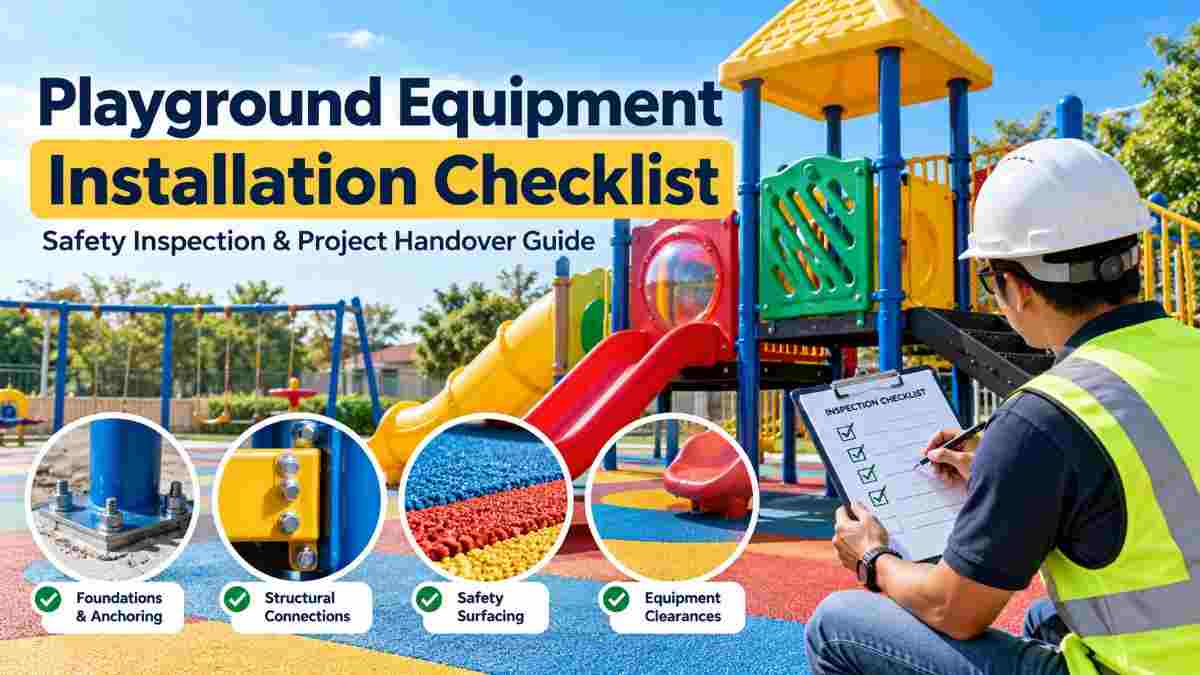
Are you preparing to accept a newly installed playground at a school, public park, residential community, or recreational facility? Before allowing children to use the equipment, it is important to verify that the playground has been installed correctly and that the site meets the applicable safety requirements.
A playground equipment installation checklist helps project owners inspect foundations, anchoring, structural connections, playground surfacing, equipment spacing, and installation documentation before accepting the completed project.
Even well-manufactured playground equipment can present hazards if it is improperly assembled, installed on unsuitable foundations, or surrounded by inadequate protective surfacing.
G.N. Enterprises manufactures and supplies outdoor playground equipment, multiplay systems, slides, and playground flooring solutions for schools, public parks, and residential communities.
This guide explains what to inspect during playground handover, which documents to request, and how to prepare a newly installed playground for safe operation.
What Should Be Included in a Playground Equipment Installation Checklist?
A playground equipment installation checklist should cover the equipment's structural stability, foundations, anchoring, fasteners, protective surfacing, safety clearances, accessibility, drainage, and final inspection documents.
A practical checklist includes:
-
Foundations: Verify that equipment foundations match the approved installation design.
-
Anchoring: Check whether equipment is securely attached to the foundations.
-
Structural connections: Inspect frames, platforms, and support components.
-
Fasteners: Look for loose bolts, exposed threads, and missing protective caps.
-
Equipment spacing: Verify appropriate clearance between play structures.
-
Protective surfacing: Confirm the required impact protection and surfacing coverage.
-
Slides and swings: Inspect equipment-specific installation and safety requirements.
-
Sharp edges: Check for protrusions, damaged components, and entanglement hazards.
-
Accessibility: Review designated accessible routes and play components.
-
Drainage: Check whether water can drain appropriately.
-
Documentation: Obtain relevant drawings, specifications, inspection records, and maintenance instructions.
The completed playground should undergo a documented inspection by a competent person before opening for public use.
Why Is a Playground Installation Inspection Important Before Handover?
A playground installation inspection is important because it helps identify assembly errors, unstable equipment, missing components, unsuitable surfacing, and other potential hazards before children begin using the playground.
Playground safety depends on both manufacturing quality and correct installation.
An inspection can help project owners:
-
Identify incomplete installation work.
-
Check compliance with approved drawings.
-
Verify equipment stability.
-
Confirm the installation of protective surfacing.
-
Identify damaged or missing components.
-
Review applicable safety requirements.
-
Document defects requiring correction.
-
Establish maintenance responsibilities.
An installation inspection does not guarantee that injuries will never occur. However, identifying potential hazards before opening is an essential risk-management measure.
How Should You Inspect Playground Equipment Foundations?
Playground equipment foundations should be inspected against the manufacturer's approved foundation drawings and relevant engineering specifications. Important checks include foundation dimensions, material requirements, location, stability, and the connection between the equipment and its supports.
Foundations provide structural support and help equipment resist the forces generated during normal use.
Before accepting an installation, verify:
-
Foundation positions match the approved layout.
-
Required depths and dimensions have been documented.
-
Concrete specifications meet the approved design.
-
Appropriate curing and strength requirements have been satisfied.
-
Equipment supports are correctly positioned.
-
Exposed foundations do not create tripping hazards.
-
Drainage does not undermine the foundation area.
A visual inspection cannot establish the strength of concealed concrete or buried foundation elements.
Ask the installation contractor for relevant construction records and engineering verification where required.
How Can You Check Whether Playground Equipment Is Properly Anchored?
Playground equipment is properly anchored when its connections to the foundations or approved supporting structure match the manufacturer's installation requirements and provide the required structural stability.
Anchoring is particularly important for equipment exposed to repeated movement, climbing loads, and other operational forces.
During inspection, check:
-
Whether all specified anchors are installed.
-
Whether anchor locations match the approved design.
-
Whether nuts and bolts are securely fastened.
-
Whether protective covers are correctly fitted.
-
Whether connections show signs of damage.
-
Whether the equipment moves unexpectedly.
-
Whether anchor components are protected against corrosion where required.
Anchor testing and torque verification should be performed according to the manufacturer's instructions by qualified personnel.
Do not use improvised pull tests or excessive force to evaluate playground stability.
What Structural Components Should You Check During Playground Installation Inspection?
Structural inspection should cover equipment frames, posts, platforms, braces, joints, guardrails, barriers, climbing elements, and other load-bearing components.
The purpose is to identify visible damage, incorrect assembly, missing connections, or departures from the approved design.
Inspect:
-
Support posts and frames.
-
Welded joints.
-
Bolted connections.
-
Elevated platforms.
-
Handrails and guardrails.
-
Protective barriers.
-
Climbing equipment.
-
Slide supports.
-
Swing frames.
-
Metal coatings and protective finishes.
Look for cracks, corrosion, deformation, damaged welds, and other signs of defective construction.
Any suspected structural defect should be evaluated and corrected before the equipment is placed into service.
How Should You Inspect Playground Bolts, Fasteners, and Hardware?
Playground bolts and fasteners should be checked for correct installation, secure connections, missing components, hazardous protrusions, and potential clothing entanglement points.
Small hardware defects can create significant risks when children climb, run, or move around play structures.
Important checks include:
-
Loose or missing fasteners.
-
Exposed sharp bolt ends.
-
Missing protective caps.
-
Open hooks that could catch clothing.
-
Incorrectly installed connectors.
-
Damaged brackets.
-
Unsecured moving components.
-
Evidence of corrosion.
The CPSC Public Playground Safety Handbook provides detailed recommendations for identifying protrusions, entanglement hazards, and unsafe hardware.
The final inspection should follow the equipment manufacturer's assembly specifications and applicable project safety requirements.
How Much Clearance Should Be Maintained Around Playground Equipment?
Playground equipment clearance depends on the equipment type, dimensions, movement patterns, and applicable safety standards. Slides, swings, climbing structures, and rotating equipment can require different protective use zones.
There is no single clearance measurement suitable for every playground component.
Important considerations include:
-
Separation between neighboring structures.
-
Slide exit areas.
-
Swing movement zones.
-
Space around climbing equipment.
-
Clearance around moving components.
-
Access for maintenance and inspection.
-
Accessible circulation routes.
For reference, the CPSC provides general playground use-zone guidance and additional equipment-specific requirements.
The manufacturer's technical drawings and applicable standards should determine the final layout.
Do not reduce specified safety clearances simply to fit additional equipment into a small playground.
How Can You Verify Playground Safety Surfacing After Installation?
Playground safety surfacing should be verified by checking that the installed system provides appropriate impact attenuation for the equipment's fall height, covers the required use zones, and matches the approved specification.
Suitable protective surfacing is particularly important beneath elevated play equipment.
A post-installation inspection should include:
-
Required surfacing coverage.
-
Applicable equipment fall heights.
-
Tested critical height of the surfacing system.
-
Installed thickness or depth.
-
Surface transitions and edges.
-
Drainage conditions.
-
Visible cracks or gaps.
-
Surface stability.
-
Accessibility requirements.
A surface that looks soft or thick is not necessarily suitable for the equipment installed above it.
How Should EPDM Rubber Flooring Be Inspected After Installation?
EPDM rubber flooring should be inspected for consistency, secure edges, appropriate drainage, visible damage, and documented impact performance.
Where the project uses a poured-in-place system, verify:
-
Approved flooring materials.
-
Specified system construction.
-
Installed layer thicknesses.
-
Surface finish and transitions.
-
Required curing conditions.
-
Impact-testing documentation.
-
Site-specific inspection results where applicable.
G.N. Enterprises offers EPDM Rubber Flooring for playground and recreational applications.
Buyers should request product-specific documentation confirming that the selected flooring system is appropriate for the installed equipment.
How Should Loose-Fill Playground Surfacing Be Inspected?
Loose-fill surfacing should be inspected for the required installed depth, coverage, drainage, and absence of hazardous objects.
Materials such as engineered wood fiber or other approved loose-fill products may shift during use.
Inspect:
-
Installed material depth.
-
Coverage within protective use zones.
-
Surface contamination.
-
Displaced material.
-
Drainage.
-
Barriers and edge restraints.
-
Accessibility where required.
The correct depth depends on the material and its tested performance.
What Should You Inspect Before Accepting Playground Slides?
Playground slides should be inspected for secure installation, smooth sliding surfaces, appropriate access, suitable side protection, safe exits, and adequate protective surfacing.
Inspect the complete slide assembly rather than only the sliding section.
Check:
-
Secure support connections.
-
Stable access steps or platforms.
-
Appropriate handrails and barriers.
-
Smooth slide surfaces.
-
No cracks or exposed sharp edges.
-
Suitable slide exit configuration.
-
Required landing and use zones.
-
Correct protective surfacing.
-
No accessible hazardous gaps or protrusions.
Slide dimensions and safety requirements should follow the relevant equipment standard and manufacturer's instructions.
A slide should remain closed if there are unresolved installation or safety defects.
What Should You Inspect Before Accepting Playground Swings?
Playground swings should be inspected for secure frame anchoring, appropriate seat and suspension components, correct clearances, and adequate protective surfacing.
Swing equipment experiences repeated movement, making its connections and moving components particularly important.
Check:
-
Swing frame stability.
-
Foundation and anchoring connections.
-
Suspension chains or other supporting components.
-
Seat attachment points.
-
Moving hardware.
-
Appropriate seat height.
-
Front and rear use zones.
-
Equipment spacing.
-
Protective surfacing.
-
Signs of binding, wear, or damage.
Swing-specific safety requirements should be verified against the applicable standard.
How Should Multiplay Systems Be Inspected Before Handover?
Multiplay systems should be inspected as complete structures, including their platforms, access components, slides, climbing features, barriers, supporting frames, and protective surfacing.
Because these systems combine multiple activities, an incomplete inspection can overlook hazards between connected components.
Inspect:
-
Overall structural stability.
-
Foundation and anchoring arrangements.
-
Platform connections.
-
Guardrails and protective barriers.
-
Climbing elements.
-
Slides and exit areas.
-
Openings that could create entrapment risks.
-
Exposed fasteners and hardware.
-
Equipment-specific use zones.
-
Surfacing and access routes.
Any modifications from the approved design should be reviewed with the manufacturer and appropriate technical professionals.
How Can You Identify Head Entrapment and Clothing Entanglement Hazards?
Head entrapment and clothing entanglement hazards can be identified by inspecting equipment openings, exposed hardware, hooks, projections, and areas where clothing or body parts could become trapped.
These hazards require evaluation using the appropriate test procedures and equipment standards.
Potential problem areas include:
Do not rely on visual judgment alone for dimensional entrapment checks.
Use qualified inspection personnel and appropriate measuring tools.
Why Should Playground Drainage Be Checked Before Handover?
Playground drainage should be checked because standing water can damage surfacing, create slippery conditions, contribute to deterioration, and interfere with equipment use.
Poor drainage may also affect foundations and surrounding landscaping.
Inspect:
-
Surface slope.
-
Drainage outlets.
-
Water accumulation near equipment.
-
Conditions beneath elevated structures.
-
Drainage around slide exits.
-
Water movement near swing areas.
-
Ground erosion around foundations.
-
Compatibility between surfacing and drainage design.
Where practical, drainage performance should be evaluated under representative water conditions.
Any significant drainage defects should be corrected before the playground opens.
How Can You Check Playground Accessibility After Installation?
Playground accessibility should be checked by reviewing the required accessible routes, entry points, surface conditions, transitions, and access to designated play components.
The completed playground should match the accessibility requirements applicable to the project.
Important checks include:
-
Step-free access where required.
-
Accessible route widths.
-
Appropriate slopes.
-
Stable and usable pathway surfaces.
-
Suitable turning areas.
-
Accessible transitions.
-
Access to required play activities.
-
Accessible seating and supporting facilities where specified.
Accessibility should be checked against the approved design and relevant requirements, not assumed from the appearance of the playground.
For projects in India, use applicable Indian accessibility requirements and local regulations.
What Documents Should You Request During Playground Equipment Handover?
A playground equipment handover checklist should include approved installation drawings, equipment specifications, inspection records, maintenance instructions, applicable test reports, and warranty documentation.
These records help owners understand what was installed and how the playground should be maintained.
Request the following, as applicable:
-
Final equipment layout.
-
Approved foundation details.
-
Installation drawings.
-
Equipment model information.
-
Product and material specifications.
-
Relevant safety testing documentation.
-
Surfacing specifications and test reports.
-
Installation inspection records.
-
Defect correction reports.
-
Warranty terms.
-
Maintenance instructions.
-
Replacement part information.
-
Supplier and service contact details.
The handover package should reflect the equipment and surfacing actually installed.
Who Should Perform the Final Playground Safety Inspection?
The final playground safety inspection should be performed by a competent person with the training and experience required for the equipment and applicable safety standards.
Depending on the project, this may involve an appropriately qualified playground inspector, engineer, accessibility specialist, or other technical professional.
The installer should also complete and document its own installation checks.
An independent inspection can provide additional assurance, particularly for public or heavily used playgrounds.
Any identified hazards should be documented, corrected, and rechecked before opening.
What Should You Do If a Playground Fails the Final Installation Inspection?
If a playground fails its final installation inspection, the affected equipment or area should remain closed until the identified defects are corrected and the necessary reinspection is completed.
A practical correction process includes:
-
Record each defect.
-
Identify the affected equipment or area.
-
Restrict public access.
-
Notify the installation contractor.
-
Determine the required corrective action.
-
Obtain necessary engineering approval.
-
Complete repairs or adjustments.
-
Arrange reinspection.
-
Update the handover documentation.
Do not allow children to use equipment with unresolved serious safety concerns.
How Often Should Playground Equipment Be Inspected After Installation?
Playground equipment should be inspected regularly according to the manufacturer's maintenance instructions, applicable standards, site conditions, and expected usage.
The inspection program should include frequent visual checks and more detailed periodic examinations.
Important factors include:
Schools and heavily used public playgrounds may require more frequent checks.
Inspection records should identify the date, findings, corrective actions, and responsible personnel.
Why Should Schools and Park Developers Consider G.N. Enterprises for Playground Installation?
G.N. Enterprises offers playground equipment and installation-related services for schools, parks, residential communities, and recreational projects.
Based in Jaipur, Rajasthan, the company supplies multiple playground equipment categories, including multiplay systems, slides, and outdoor recreational products.
Its website also provides information about its playground installation process and EPDM surfacing solutions.
Project owners can review:
Before approving a project, request the specifications, documentation, and installation arrangements relevant to the selected products.
What Information Should You Share When Requesting Playground Equipment Installation?
A playground installation enquiry should include the site location, available dimensions, equipment requirements, ground conditions, intended age groups, surfacing requirements, and expected project schedule.
Provide:
-
Project type: School, park, residential community, or recreational area.
-
Location: Installation city and site address.
-
Area: Available playground dimensions.
-
Equipment: Required slides, swings, or multiplay systems.
-
Age group: Intended equipment users.
-
Ground conditions: Existing surface and site preparation needs.
-
Surfacing: Required safety flooring.
-
Accessibility: Relevant access requirements.
-
Installation: Foundation and site access details.
-
Timeline: Preferred project schedule.
-
Documentation: Required inspection and handover records.
Site photographs and layout drawings can help communicate project requirements.
What Are the Most Frequently Asked Questions About Playground Equipment Installation?
Common playground installation questions concern inspection requirements, foundations, surfacing, certification, and the documents needed before a playground opens.
Is a Playground Installation Inspection Necessary Before Opening?
Yes. A documented installation inspection is an important safety measure before opening a new playground. Any additional legal or contractual inspection requirements depend on the project's location and applicable standards.
Can Children Use Playground Equipment Immediately After Installation?
Not automatically. The equipment should remain closed until installation is complete, surfacing and foundations are ready, required curing has finished, and applicable inspections have been completed.
Who Is Responsible for Playground Equipment Safety After Handover?
The playground owner or operator generally has ongoing responsibilities for inspection, maintenance, and safe operation, subject to applicable laws and contractual arrangements. Installer and manufacturer obligations depend on the agreement and relevant requirements.
Does New Playground Equipment Need Protective Surfacing?
Elevated playground equipment generally requires suitable protective surfacing within the applicable use zones. The required system depends on the equipment and relevant safety standards.
Can Playground Equipment Be Installed on Concrete?
Playground equipment may be anchored to appropriately engineered concrete foundations, but exposed concrete is not suitable protective surfacing within fall zones. A compliant impact-attenuating system is needed where required.
How Can You Tell Whether Playground Equipment Is Properly Anchored?
Anchoring should be checked against approved installation drawings, manufacturer instructions, and relevant inspection procedures. Visual appearance alone is not sufficient to verify concealed structural performance.
Should Schools Request Playground Safety Test Reports?
Yes. Schools should request relevant product and surfacing safety documentation required by their applicable standards, procurement specifications, and project contracts.
What Happens If Equipment Is Damaged During Installation?
Damaged equipment should be assessed and repaired or replaced as appropriate before use. Repairs affecting structural or safety performance may require manufacturer approval and reinspection.
Does Playground Equipment Require Maintenance After Installation?
Yes. Regular inspections, cleaning, component checks, and prompt repairs are necessary throughout the equipment's service life.
Can G.N. Enterprises Provide Playground Installation Information?
Yes. G.N. Enterprises has a dedicated installation page describing its playground installation services. Buyers should confirm project-specific scope, availability, and handover arrangements directly.
How Can You Request a Playground Equipment Installation Quotation From G.N. Enterprises?
You can request a playground equipment installation quotation from G.N. Enterprises by sharing your project location, playground area, selected equipment, ground conditions, safety surfacing requirements, and expected timeline.
A complete project enquiry helps the supplier evaluate the installation requirements and provide relevant product and service information.
Before accepting any playground installation, confirm that the completed equipment matches approved specifications and that applicable safety, surfacing, and inspection requirements have been addressed.
Planning a new school playground, public park, or residential play area?
Explore G.N. Enterprises Playground Installation Services, review the EPDM Rubber Flooring Solutions, or contact G.N. Enterprises for a project quotation.