Which playground equipment works best for toddlers, juniors, and older kids?
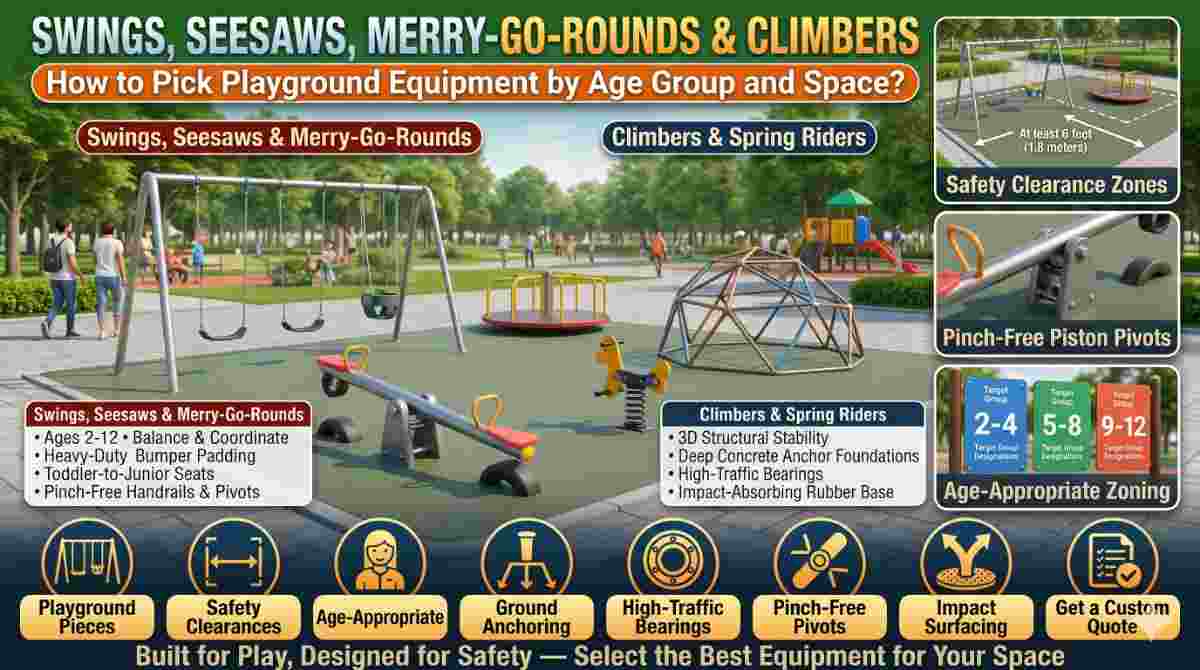
Choosing playground equipment by age group ensures children face age-appropriate physical challenges without unnecessary injury risks. Toddlers aged 2 to 4 thrive on low-height spring riders and bucket-seat swings, juniors aged 5 to 8 enjoy standard belt swings, seesaws, and low merry-go-rounds, while older kids aged 9 to 12 gravitate toward tall climbers, fast spinners, and dynamic multi-station structures.
Separating play equipment by developmental stage prevents older children from accidentally colliding with younger toddlers in high-traffic schoolyards or residential parks. When sourcing standalone units from G. N. Enterprises, pairing gentle toddler pieces like playground swings with dedicated junior and pre-teen zones creates an inclusive layout that serves every child safely.
How much safety fall zone clearance is needed around swings, seesaws, and merry-go-rounds?
Safety fall zone clearances depend on equipment motion and pivot height, requiring at least 6 feet (1.8 meters) of unobstructed perimeter around stationary climbers and merry-go-rounds, and twice the pivot height in front of and behind swings. Seesaws require a minimum 6-foot clearance in all directions from the outermost edge of the beam to prevent collisions with bystanders or neighboring play units.
Overlapping fall zones is one of the most common layout mistakes in compact residential societies and preschools. Installing heavy-duty playground seesaws and rotating merry-go-rounds with dedicated rubberized or sand impact surfacing inside their full clearance arcs keeps active play safe even during peak recess hours.
What structural features prevent tipping, pinch points, and bearing wear in high-traffic parks?
Preventing structural failures in public parks requires deep concrete anchor foundations, sealed heavy-duty bearings on rotating joints, rubber impact bumpers beneath seesaw seats, and enclosed pinch-free pivot mechanisms. Using thick-walled galvanized iron (GI) pipes with baked powder coatings stops rust from weakening weld joints during monsoon seasons.
On rotating units and swings, low-grade open bearings quickly seize or squeak under daily dust and heavy loads. Choosing precision-engineered playground climbers and commercial-grade motion equipment built to EN-1176 standards ensures smooth rotation, stable ground anchoring, and minimal maintenance across years of continuous school or municipal use.
How do you balance standalone equipment with a multiplay station on a fixed budget?
Balancing standalone equipment with a multiplay station works best by anchoring the center of your site with a compact multi-activity tower and placing high-turnover motion pieces—like a two-bay swing set, a seesaw, and two spring riders—around the perimeter. This approach maximizes simultaneous play capacity per square foot while keeping pathways open and sightlines clear for teachers and parents.
Instead of spending your entire budget on a single oversized structure, combining an outdoor multiplay system with three or four standalone motion units spreads children evenly across the ground and eliminates long queues. Facility planners can also review spacing checklists and maintenance guides on the G. N. Enterprises blog to fine-tune equipment mixes before finalizing orders.
How should schools and societies prepare before requesting a custom playground layout?
Schools and housing societies should measure the exact length and width of the usable plot, note fixed obstacles like trees or boundary walls, and list the target age brackets and approximate number of children using the space at once. Sharing your site dimensions and budget range allows a manufacturer to generate an accurate 3D layout plan with verified fall zones.
Whether you are outfitting a new preschool courtyard, a residential township park, or a municipal recreation project, you can request a custom 3D layout and quote to match the right swings, seesaws, merry-go-rounds, and climbers to your exact space.