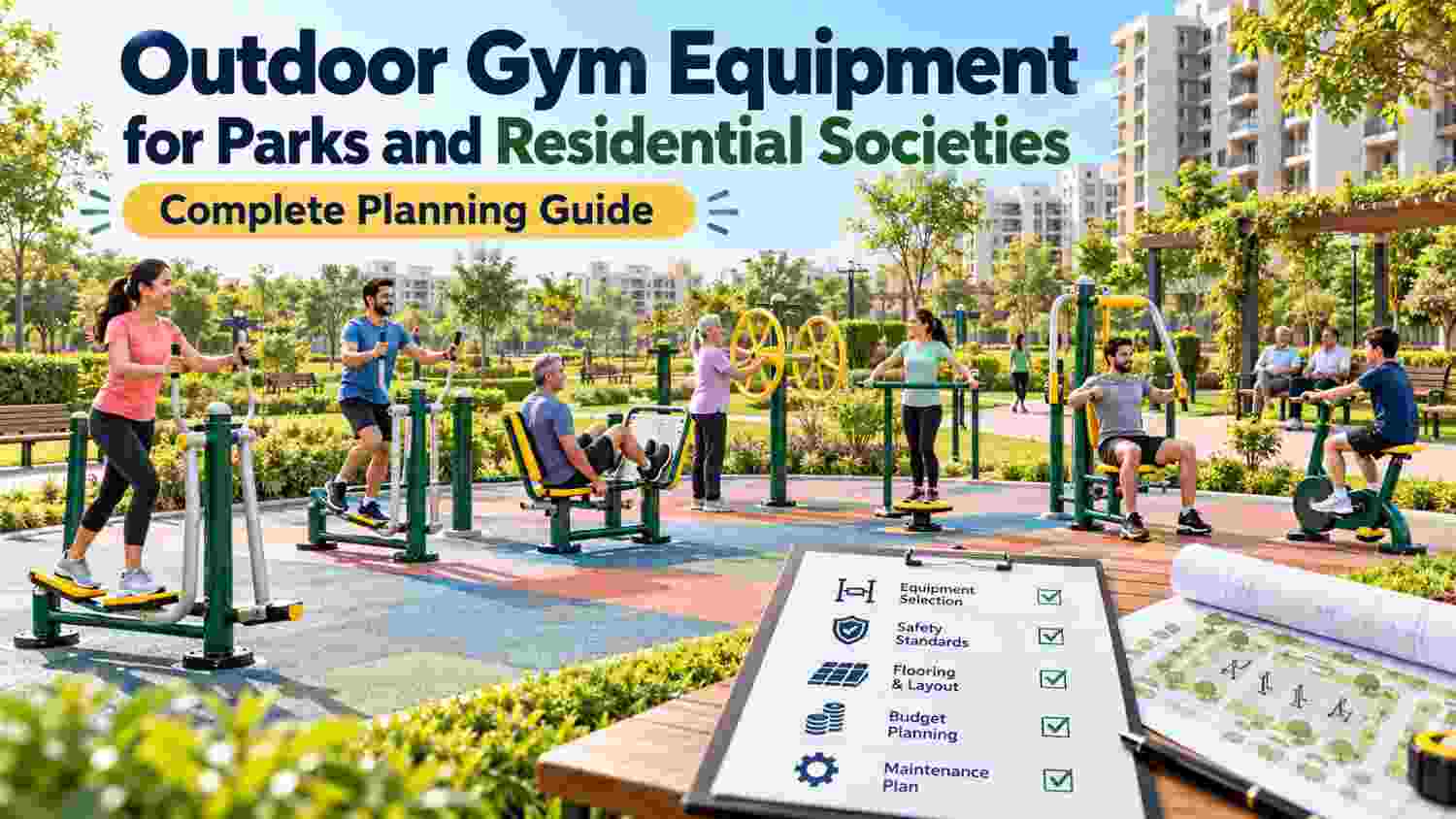
Outdoor fitness areas are becoming increasingly popular in public parks, residential societies, housing projects, schools, institutions, and community spaces.
They provide people with an accessible way to exercise outdoors without requiring a traditional indoor gym setup.
However, installing a few random fitness machines is not enough to create an effective outdoor gym.
The equipment needs to be selected according to the available space, expected users, exercise requirements, durability, safety, flooring, and long-term maintenance.
So, how should an outdoor gym be planned properly?
At G.N. Enterprises, outdoor fitness solutions can be planned according to project size, user requirements, available space, and budget.
This guide explains what buyers should consider before selecting outdoor gym equipment for parks and residential societies.
What Is Outdoor Gym Equipment?
Outdoor gym equipment is fitness equipment designed for installation in open spaces such as:
-
Public parks
-
Residential societies
-
Housing developments
-
Schools
-
Colleges
-
Community centres
-
Resorts
-
Corporate campuses
-
Institutional grounds
Unlike conventional indoor gym machines, outdoor fitness equipment is designed to operate in external conditions.
It may use body weight, resistance mechanisms, moving components, or fixed exercise stations to support different types of physical activity.
Why Are Outdoor Gyms Becoming Popular in Parks and Societies?
Outdoor gyms provide a convenient fitness option within community spaces.
Residents and park visitors do not need to travel to a commercial gym to perform basic physical activity.
An outdoor fitness zone can also encourage people to:
For residential societies, an outdoor gym can also add value to the overall recreational infrastructure of the property.
Which Outdoor Gym Equipment Is Best for Parks?
Public parks often serve users with different fitness levels and age groups.
For this reason, the equipment mix should ideally include multiple types of exercises rather than focusing on one body area.
Common outdoor gym equipment for parks may include:
-
Air walkers
-
Cross trainers
-
Leg press machines
-
Shoulder wheels
-
Waist twisters
-
Chest press machines
-
Pull-down equipment
-
Rowing-style machines
-
Cycle-based equipment
-
Stepper machines
-
Stretching stations
The exact selection depends on the available area and intended users.
Which Outdoor Gym Equipment Is Suitable for Residential Societies?
Residential societies often require compact, low-maintenance equipment that can serve a wide range of residents.
A basic outdoor fitness area may include:
-
Air walker
-
Waist twister
-
Leg press
-
Shoulder wheel
-
Cross trainer
-
Chest press
-
Exercise cycle
Larger residential developments may install several additional machines to create a dedicated fitness zone.
The goal should be to create a balanced exercise area rather than filling the space with equipment that performs similar movements.
How Much Space Is Required for an Outdoor Gym?
The space requirement depends on:
-
Number of machines
-
Size of each unit
-
Required clearance
-
Walking paths
-
User movement
-
Flooring
-
Landscaping
A compact residential fitness area may only require a few carefully selected machines.
A large public park may have enough space for several fitness stations arranged along a walking track or within a dedicated gym zone.
Every machine should have sufficient space around it so that users can exercise comfortably without interfering with nearby equipment.
How Should Outdoor Gym Equipment Be Arranged?
A good layout can make an outdoor gym easier and safer to use.
Equipment should be arranged according to:
-
Exercise type
-
Machine movement
-
User circulation
-
Visibility
-
Available space
-
Safety clearance
For example, machines with moving arms or pedals should not be placed too close to pathways or neighbouring equipment.
A practical layout may group exercises into areas such as:
-
Cardio
-
Upper body
-
Lower body
-
Mobility
-
Stretching
This can make the fitness zone easier to understand and use.
What Material Is Best for Outdoor Gym Equipment?
Outdoor gym equipment usually requires strong metal construction because it needs to withstand regular use and outdoor exposure.
Common materials may include:
The ideal material depends on the equipment design, project location, budget, and expected usage.
Surface treatment is particularly important because the equipment may be exposed to:
-
Sunlight
-
Rain
-
Dust
-
Humidity
-
Frequent handling
Good finishing can help improve corrosion resistance and overall appearance.
Is Powder-Coated Outdoor Gym Equipment Durable?
Powder coating is commonly used on outdoor fitness equipment to create a finished protective surface.
A good coating can improve resistance to:
-
Corrosion
-
Scratches
-
Weather exposure
-
General wear
However, long-term durability depends on the complete manufacturing process, including:
-
Metal quality
-
Surface preparation
-
Welding
-
Coating thickness
-
Installation
-
Maintenance
Buyers should therefore evaluate construction quality rather than selecting equipment based only on colour or appearance.
Is Outdoor Gym Equipment Safe to Use?
Outdoor fitness equipment can be safe when it is properly designed, installed, inspected, and maintained.
Safety considerations may include:
-
Stable foundations
-
Proper anchoring
-
Smooth edges
-
Secure handles
-
Controlled moving parts
-
Suitable spacing
-
Clear usage instructions
-
Regular inspection
The equipment should also be appropriate for the intended users.
Children should not be encouraged to use fitness machines that are designed specifically for adults unless the equipment is suitable for their age and use.
Does Outdoor Gym Equipment Need Flooring?
Flooring is an important part of planning an outdoor fitness area.
Depending on the project, possible flooring options may include:
The surface should provide stable footing and should not create unnecessary trip hazards.
In some projects, different flooring colours can also be used to visually separate the outdoor gym from playground or walking areas.
Can Outdoor Gym Equipment Be Installed in a Playground?
It can be installed within the same recreational property, but the outdoor gym should ideally be separated from children's playground equipment.
Playgrounds and fitness areas serve different users and involve different types of movement.
A better layout may include:
Separating the zones can make the overall space easier and safer to use.
What Exercises Can Be Done on Outdoor Gym Equipment?
Different machines support different types of movement.
For example:
-
Air walkers support lower-body movement and light cardio activity
-
Shoulder wheels support upper-body mobility
-
Waist twisters support rotational movement
-
Leg press machines target lower-body muscles
-
Chest press machines support pushing movements
-
Pull-down machines support upper-body pulling movements
-
Cross trainers provide full-body movement
An outdoor gym should ideally include a combination of equipment to support different movement patterns.
Is Outdoor Gym Equipment Suitable for Senior Citizens?
Some outdoor fitness equipment can be suitable for older adults, especially machines designed for controlled movement and mobility.
Potentially useful equipment may include:
-
Shoulder wheels
-
Waist twisters
-
Air walkers
-
Gentle cycling equipment
-
Stretching stations
However, equipment selection should take into account the expected users.
Residential societies with a large senior population may prioritize low-impact equipment rather than machines requiring significant strength or balance.
Clear instructions can also make the equipment easier to use.
How Many Outdoor Gym Machines Should a Society Install?
There is no fixed number.
The right quantity depends on:
-
Available space
-
Number of residents
-
Budget
-
Expected usage
-
Variety of exercises
A smaller society may start with a few essential machines.
A larger project may require a more complete fitness zone with multiple stations.
Instead of purchasing many machines with similar functions, it is often better to select a smaller but more balanced mix.
How Much Does Outdoor Gym Equipment Cost in India?
The cost of outdoor gym equipment in India depends on several factors.
These may include:
-
Type of machine
-
Material
-
Size
-
Design
-
Number of stations
-
Coating
-
Installation
-
Transportation
-
Flooring
-
Project location
A project involving three or four machines will naturally have a different cost from a complete public park fitness zone.
For an accurate quotation, buyers should provide the manufacturer with site details and required equipment.
What Affects the Cost of an Outdoor Gym Project?
The final project cost can be influenced by more than the price of the machines.
Additional factors may include:
-
Ground preparation
-
Concrete foundations
-
Installation
-
Transportation
-
Safety flooring
-
Landscaping
-
Customized colours
-
Signage
Buyers should therefore calculate the project as a complete fitness area rather than comparing only individual machine prices.
Can an Outdoor Gym Be Set Up on a Limited Budget?
Yes.
If the budget is limited, the project can be planned in phases.
A residential society may initially install essential machines such as:
-
Air walker
-
Leg press
-
Waist twister
-
Shoulder wheel
-
Chest press
Additional equipment can be introduced later.
Prioritizing machines that offer different exercise functions can help provide better value from a smaller initial investment.
Should You Choose the Cheapest Outdoor Gym Equipment?
Price should be considered, but it should not be the only deciding factor.
Low-cost equipment may result in additional expenses if it experiences:
-
Corrosion
-
Loose joints
-
Structural damage
-
Frequent breakdowns
-
Coating failure
-
Early replacement
Buyers should also evaluate:
-
Material quality
-
Welding
-
Surface finish
-
Moving components
-
Installation
-
Manufacturer support
-
Maintenance requirements
Long-term durability can be more important than the lowest initial quotation.
How Important Is Installation for Outdoor Gym Equipment?
Installation has a major impact on equipment stability and user safety.
Depending on the equipment, installation may involve:
-
Foundation preparation
-
Concrete work
-
Anchoring
-
Alignment
-
Assembly
-
Final checks
Incorrect installation can create instability even when the equipment itself is well manufactured.
Before placing an order, buyers should confirm whether installation is included in the quotation.
How Often Should Outdoor Gym Equipment Be Maintained?
Outdoor fitness equipment should be inspected regularly.
Maintenance may include checking:
-
Bolts and fasteners
-
Moving joints
-
Bearings
-
Handles
-
Footrests
-
Welded joints
-
Coating condition
-
Corrosion
-
Foundations
Machines installed in heavily used public parks may require more frequent inspection than equipment used by a smaller residential community.
Routine maintenance can help identify minor problems before they become serious.
Should Outdoor Gym Equipment Have Instruction Boards?
Yes, clear instructions can improve usability.
An instruction panel may explain:
This is particularly helpful in public parks where users may be unfamiliar with the machines.
Instructions should be simple and easy to understand.
Can Outdoor Gym Equipment Be Customized?
Depending on the manufacturer, customization may include:
Residential societies, institutions, and developers may choose colours that match the overall landscape or property design.
However, customization should not compromise usability or structural performance.
What Should Buyers Check Before Choosing an Outdoor Gym Manufacturer?
Before selecting a supplier, buyers should consider:
If possible, reviewing completed projects can also help assess equipment quality and finish.
What Information Should You Provide Before Requesting a Quote?
To receive a more accurate quotation, buyers should provide:
Site photographs or layout drawings can also help the manufacturer recommend suitable equipment placement.
How Can G.N. Enterprises Help With Outdoor Gym Projects?
G.N. Enterprises provides outdoor fitness and recreational equipment solutions for different types of projects.
Outdoor gym solutions can be planned for:
-
Public parks
-
Residential societies
-
Schools
-
Institutions
-
Housing developments
-
Resorts
-
Community spaces
Depending on project requirements, equipment can be selected according to the available space, intended users, exercise needs, and budget.
Outdoor fitness equipment can also be planned alongside playground equipment and recreational areas where a complete park or society project is required.
What Is the Best Way to Plan an Outdoor Gym?
The best approach is to treat the outdoor gym as a complete fitness zone.
Start by identifying:
-
Available space
-
Intended users
-
Exercise requirements
-
Equipment categories
-
Flooring
-
Budget
-
Installation needs
-
Maintenance plan
Once these requirements are clear, equipment can be selected and positioned more effectively.
Final Thoughts
Installing outdoor gym equipment for parks and residential societies can create a useful fitness facility within an existing recreational space.
However, the success of the project depends on more than simply purchasing exercise machines.
Equipment selection, material quality, layout, flooring, installation, safety, and maintenance should all be considered during planning.
For public parks, residential developments, schools, institutions, and community spaces, a balanced mix of outdoor fitness equipment can help create a more functional and engaging recreational environment.
Working with an experienced outdoor gym equipment manufacturer can also make it easier to select suitable machines and plan the overall fitness zone according to the available space and project budget.