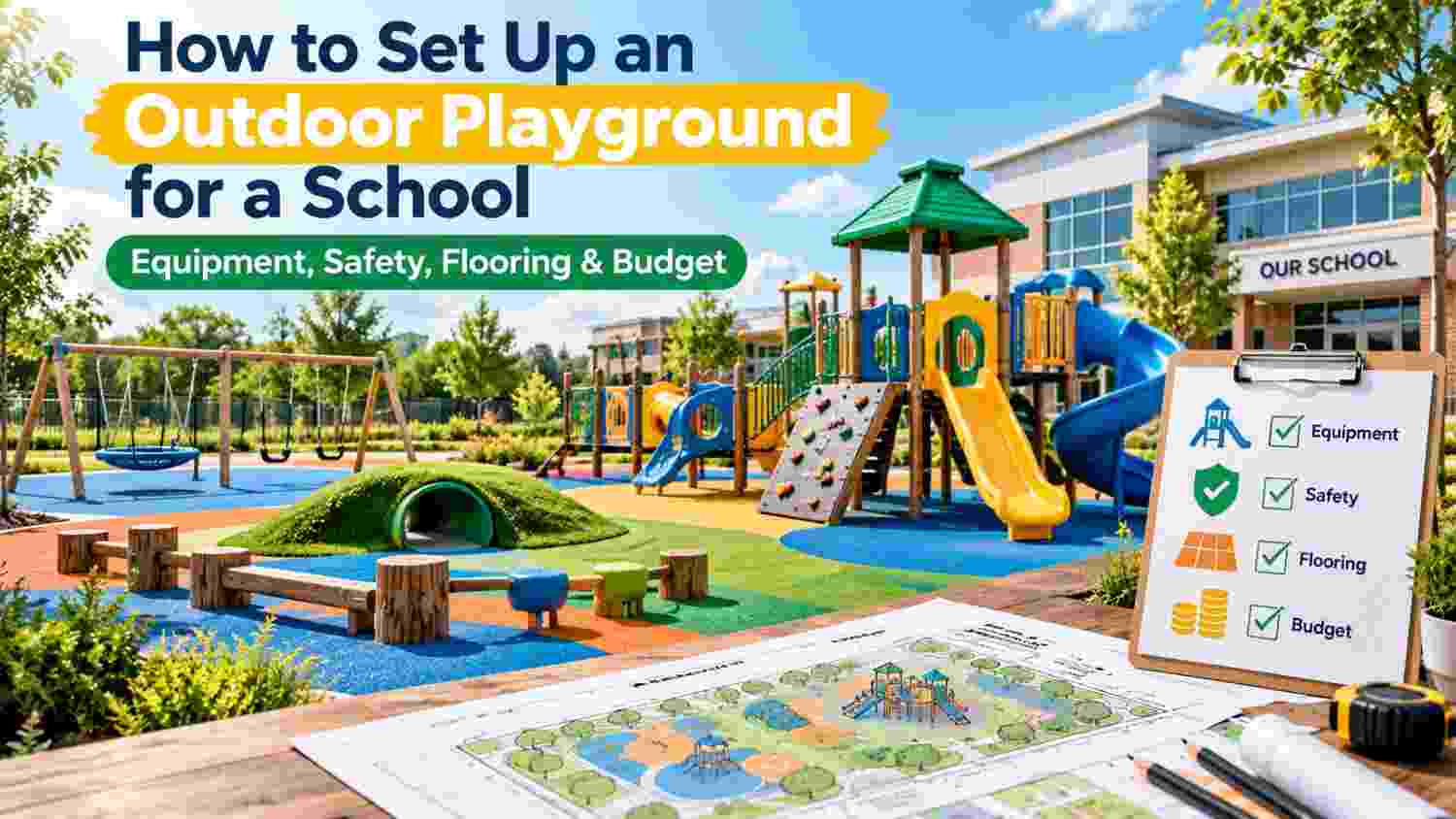
Setting up a school playground requires more than choosing a few swings and slides.
A well-planned playground should support physical activity, coordination, social interaction, and age-appropriate play while also making efficient use of the available space and budget.
For schools, one of the biggest challenges is balancing equipment selection, safety, flooring, layout, durability, and cost.
So, how do you plan a school playground properly?
At G.N. Enterprises, outdoor playground solutions can be planned according to the school’s available space, student age groups, expected usage, and project requirements.
This guide explains the key steps involved in setting up an outdoor playground for a school.
What Should a School Consider Before Setting Up a Playground?
Before selecting any playground equipment, the school should first evaluate the site and project requirements.
Important factors include:
-
Available playground area
-
Age group of students
-
Number of children expected to use the area
-
Budget
-
Type of play activities required
-
Safety flooring requirements
-
Installation conditions
-
Weather exposure
-
Maintenance needs
Starting with these factors can help avoid purchasing equipment that is unsuitable for the available space.
How Much Space Is Needed for a School Playground?
The amount of space required depends on the number and type of playground activities planned.
A small preschool or primary school playground may only need enough space for:
A larger school may require separate areas for:
Schools should also leave sufficient space around each piece of equipment rather than filling every available area.
Proper spacing helps improve movement, visibility, and safety.
Which Playground Equipment Is Best for Schools?
The ideal equipment depends on the age group and expected usage.
Common school playground equipment may include:
For larger schools, combining individual equipment with a multiplay system can provide children with a wider range of activities.
Are Multiplay Systems Suitable for School Playgrounds?
Yes.
Multiplay systems are popular for school playgrounds because they combine several play activities within one structure.
A multiplay system may include:
-
Slides
-
Climbers
-
Bridges
-
Tunnels
-
Platforms
-
Steps
-
Activity panels
-
Interactive features
This can be useful where schools want to provide multiple activities without installing a large number of separate products.
Multiplay systems can also help make better use of limited playground space.
How Should Playground Equipment Be Selected for Different Age Groups?
Children of different ages have different physical abilities and play requirements.
Equipment for younger children should generally be lower, simpler, and easier to access.
For older children, playground equipment may include more challenging activities such as:
-
Climbing
-
Balancing
-
Multi-level structures
-
Adventure elements
-
Larger slides
If a school serves multiple age groups, creating separate activity areas can be a practical approach.
This helps prevent very young children from using equipment designed for older students.
Which Material Is Best for School Playground Equipment?
School playground equipment may use a combination of materials.
Common materials include:
-
LLDPE
-
FRP
-
Mild steel
-
Galvanized iron
-
Stainless steel
-
Rubber or EPDM flooring
LLDPE is commonly used for slides, tunnels, roofs, and activity panels because it provides smooth molded surfaces.
FRP can be useful for customized and theme-based components.
Metal is generally used for structural frames, supports, climbers, swings, and other load-bearing parts.
The best solution is often a combination of materials rather than relying on a single material throughout the playground.
Why Is Playground Safety Important for Schools?
School playgrounds may be used repeatedly throughout the day, which makes safety an important part of the planning process.
Potential risks can arise from:
-
Poor installation
-
Sharp edges
-
Loose fasteners
-
Damaged equipment
-
Inadequate spacing
-
Hard flooring
-
Improper foundations
-
Worn components
Schools should therefore evaluate both equipment design and installation quality.
Regular inspection is also important after the playground becomes operational.
What Safety Features Should School Playground Equipment Have?
A school should look for equipment with features such as:
The playground layout should also allow teachers and staff to supervise children easily.
Visibility across the play area is an important consideration when planning the equipment placement.
Is EPDM Flooring Good for School Playgrounds?
EPDM flooring is commonly used in playground areas because it creates a cushioned, colourful surface.
It can be installed around:
-
Multiplay systems
-
Slides
-
Swings
-
Climbers
-
Activity zones
EPDM flooring can also improve the visual appearance of the playground and help create different play zones through the use of colours and patterns.
The required thickness and installation method depend on the playground design and site requirements.
What Are the Alternatives to EPDM Playground Flooring?
Depending on the project, other surfaces may also be considered.
These can include:
Each option has different characteristics in terms of:
-
Cost
-
Maintenance
-
Appearance
-
Drainage
-
Durability
-
Impact absorption
The flooring should be selected based on the type and height of equipment being installed.
How Should a School Playground Layout Be Planned?
A good playground layout should allow children to move between different activities without unnecessary congestion.
The planning process can include:
-
Measuring the total available area
-
Identifying entry and exit points
-
Selecting appropriate equipment
-
Defining safety zones around equipment
-
Separating high-activity and low-activity areas
-
Planning flooring
-
Maintaining supervision visibility
-
Providing walking and circulation space
The equipment should not simply be placed wherever empty space is available.
The entire playground should function as a connected recreational area.
Should Swings Be Installed Away From Other Equipment?
In many layouts, swings benefit from having a dedicated area because the moving seats require clear space in front and behind the equipment.
Placing a swing directly beside a busy walkway or another play activity may create unnecessary conflicts.
The same principle applies to other moving equipment.
When planning the playground, schools should consider how children will move around each structure while it is being used.
How Much Does a School Playground Cost?
The total school playground equipment cost depends on the project size and equipment selected.
Important cost factors include:
A small school playground will naturally require a different investment from a large campus with multiple play zones.
For this reason, schools should request quotations based on the actual site dimensions and requirements.
How Can Schools Plan a Playground Within a Limited Budget?
A limited budget does not necessarily mean a school cannot create an effective playground.
The key is to prioritize activities.
For example, a school may begin with:
Additional equipment can be added later as the budget increases.
Another approach is to choose equipment that provides multiple activities within one structure.
This can help maximize the value of the available space and budget.
Should Schools Buy Cheap Playground Equipment?
Schools should be careful about choosing equipment solely because it has the lowest price.
Very low-cost equipment may create additional expenses if it requires frequent repair, repainting, part replacement, or early replacement.
Instead, schools should compare:
-
Material quality
-
Structural strength
-
Finish
-
Installation quality
-
Maintenance needs
-
Expected lifespan
-
After-sales support
Long-term value is often more important than the initial purchase price.
Is Customized Playground Equipment Useful for Schools?
Yes, particularly when the school has unusual space restrictions or wants a specific visual theme.
Customization can include:
However, customization can increase project cost, so schools should determine whether the additional design work provides practical value.
How Important Is Installation Quality?
Installation is one of the most important parts of a playground project.
Even high-quality equipment may create problems if it is installed incorrectly.
Installation can involve:
-
Foundation work
-
Anchoring
-
Equipment alignment
-
Fastener tightening
-
Flooring installation
-
Final safety inspection
Schools should confirm whether installation is included in the supplier’s quotation and who will be responsible for completing the work.
How Often Should School Playground Equipment Be Inspected?
Regular inspection helps identify wear and damage before they become serious problems.
Schools can check playground equipment for:
-
Loose bolts
-
Damaged chains
-
Cracks
-
Corrosion
-
Worn surfaces
-
Damaged flooring
-
Sharp edges
-
Unstable components
Equipment that receives heavy daily use should be monitored more frequently.
A simple maintenance and inspection routine can help extend equipment life.
Should Schools Include Outdoor Gym Equipment?
Outdoor fitness equipment may be useful for schools with older students or larger campuses.
It can provide additional physical activity options beyond traditional playground equipment.
Depending on the school, outdoor fitness areas may include equipment designed for:
-
Stretching
-
Leg movement
-
Arm exercise
-
Cardio activity
-
General fitness
These areas should generally be separated from equipment intended for younger children.
What Information Should Schools Share With a Playground Manufacturer?
Before requesting a quotation, schools should ideally provide:
-
Site dimensions
-
Playground photographs
-
Student age groups
-
Number of expected users
-
Equipment preferences
-
Flooring requirements
-
Budget range
-
Installation location
-
Project timeline
Providing this information can help the manufacturer recommend a more suitable playground layout.
How Can G.N. Enterprises Help With School Playground Projects?
G.N. Enterprises provides outdoor playground equipment and recreational solutions suitable for schools and other institutional projects.
Depending on the project requirements, solutions can include:
Equipment can be selected according to the available space, required activities, age group, and project budget.
What Is the Best Way to Plan a School Playground?
The best approach is to treat the playground as a complete project rather than purchasing individual equipment without a plan.
Schools should first define:
-
Who will use the playground
-
How much space is available
-
Which activities are most important
-
What safety measures are needed
-
What budget is available
Once these requirements are clear, suitable equipment and flooring can be selected more effectively.
Final Thoughts
Setting up an outdoor playground for a school requires careful planning.
The right playground should balance equipment variety, available space, age groups, safety, flooring, durability, and budget.
Instead of simply filling the area with as much equipment as possible, schools should create a layout that gives children enough space to play comfortably and allows staff to supervise the area effectively.
A well-planned school playground can provide students with opportunities for physical activity, social interaction, coordination, and enjoyable outdoor play.
Working with an experienced playground equipment manufacturer can also make it easier to select suitable equipment, plan the layout, and manage installation according to the project requirements.