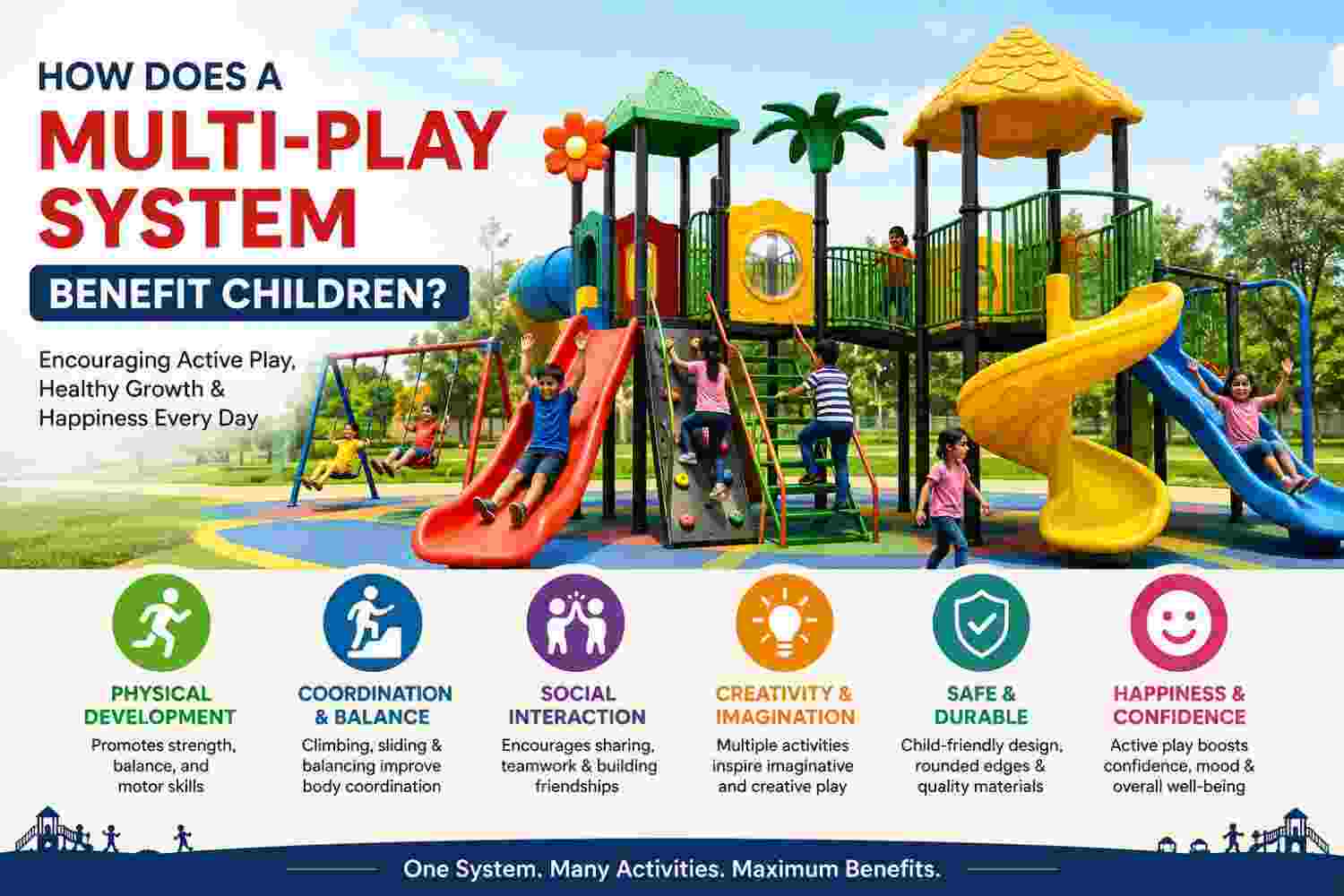
A multi-play system benefits children by combining several play activities into one structured playground setup, encouraging physical movement, coordination, social interaction, creativity, and active outdoor play. Because multiple activities can be integrated into one system, it can also make effective use of available playground space.
Multi-play systems are commonly designed for schools, parks, residential societies, malls, and other recreational spaces. Their modular construction allows different slides, climbing elements, bridges, tunnels, and activity features to be combined according to the intended space and user requirements.
What Is a Multi-Play System?
A multi-play system is an integrated playground structure that combines several activities into one connected play environment.
Instead of installing individual playground items separately, a multi-play structure can bring different activities together.
Depending on the design, it may include:
- Straight, spiral, tube, or wave slides
- Rock walls
- Rope ladders
- Climbing elements
- Bridges
- Tunnels
- Crawl-through passages
- Monkey bars
- Swings
- Activity panels
These features allow children to move between different activities within the same playground structure.
How Does a Multi-Play System Support Children's Physical Development?
A multi-play system encourages children to climb, slide, balance, move, and explore, helping them stay physically active during play.
Different playground activities require different types of movement.
For example, climbing activities can encourage children to use their arms and legs, while slides and bridges involve movement, balance, and coordination.
A thoughtfully designed play structure can therefore provide opportunities for children to develop movement skills while enjoying recreational activities.
How Does Playground Equipment Improve Coordination?
Multi-play equipment can encourage coordination by requiring children to control their body movements while navigating different play elements.
Climbing, crossing bridges, using ladders, and moving through tunnels can require children to coordinate their hands, feet, balance, and body position.
Repeated participation in these activities can make playground time more active and engaging.
Can Multi-Play Systems Encourage Social Interaction?
Yes, multi-play systems can create opportunities for children to interact, cooperate, and share play activities with other children.
Unlike a single-use playground item, a multi-play structure can contain several interconnected activities.
Children may:
- Play alongside each other
- Take turns using equipment
- Explore different sections together
- Participate in group activities
- Communicate while playing
- Navigate shared play spaces
The source page specifically positions multi-play systems as environments that support social connectedness and interaction.
Why Are Multiple Activities Combined Into One Structure?
Combining multiple activities into one structure allows children to experience different types of play within the same playground installation.
A single system can incorporate slides, climbing features, bridges, tunnels, and interactive elements.
This approach can also make better use of available space because several play functions are organized within one connected structure.
For schools and public playgrounds, this can provide a more varied play experience without requiring every activity to occupy a completely separate installation.
How Does a Multi-Play System Encourage Active Play?
A multi-play system encourages active play by giving children multiple opportunities to move rather than remaining in one stationary activity.
Children can move from one section to another, climb, cross, slide, and explore.
This variety can make playground sessions more engaging and encourage children to participate in physical recreation.
Can Multi-Play Systems Support Imaginative Play?
Yes, interconnected playground elements can provide children with opportunities to explore and create their own styles of play.
Tunnels, bridges, climbing areas, slides, and activity panels can become different parts of an imaginative play environment.
Children may explore the structure in different ways depending on their age, interests, and confidence.
The source page describes multi-play systems as supporting both imaginative exploration and creative play.
What Age Group Can Use a Multi-Play System?
The suitable age group depends on the specific design, platform height, activities, and configuration of the playground system.
The supplied page describes multi-play systems as being designed for children approximately 3 to 14 years old, while its technical information provides different platform-height options for different age ranges.
For example, the listed configurations include:
- 3 ft decks for toddlers
- 4–5 ft platforms for junior play levels
- 6–7 ft platforms for standard multi-play structures
- 8–9 ft platforms for adventure-level structures
Age suitability should always be evaluated against the actual equipment design and manufacturer's specifications.
How Many Children Can Use a Multi-Play System?
The number of children a multi-play system can accommodate depends on its size, configuration, and design.
The source information indicates that systems can be configured for different user capacities, from smaller installations to structures designed for more than 30 children.
This makes capacity an important consideration when selecting equipment for:
- Small schools
- Residential societies
- Public parks
- Community playgrounds
- Large recreational areas
A high-traffic playground generally requires a configuration appropriate for its expected user load.
What Materials Are Used in Multi-Play Systems?
The supplied page identifies FRP, LLDPE, HDPE, engineering-grade plastic, and galvanised steel among the materials used for different structural and play components.
Each material can serve a different purpose.
FRP
FRP can provide a strong, weather-resistant, and corrosion-resistant option for suitable playground components.
LLDPE
LLDPE can provide a smooth finish and UV-stabilized construction for appropriate playground components.
HDPE
HDPE is identified for impact resistance and long-life performance.
Galvanised Steel
Galvanised steel can provide strength and corrosion resistance for structural frameworks.
The exact material combination depends on the system design and component.
Why Is Weather Resistance Important for Outdoor Playgrounds?
Weather-resistant materials are important because outdoor playground equipment remains exposed to changing environmental conditions.
The supplied page highlights weather and corrosion resistance as important characteristics of the materials used in its multi-play systems.
For outdoor installations, material selection can therefore affect:
- Long-term appearance
- Surface condition
- Structural durability
- Maintenance requirements
- Resistance to environmental exposure
How Important Are Rounded Edges and Anti-Slip Platforms?
Rounded edges and anti-slip platforms are important design features for creating a safer play environment.
The source page identifies rounded edges, anti-slip platforms, and child-friendly designs as measures intended to reduce potential injury risks during play.
Other safety-related features mentioned include:
- Burr-free edges
- UV-stabilized surfaces
- Non-toxic coatings
- Suitable fasteners
- Stable installation
- Strong joints
These features should be evaluated as part of the overall playground design rather than individually.
Why Is Quality Inspection Important for Multi-Play Systems?
Quality inspection helps check structural integrity, stability, finishing, and the condition of important components before the equipment is used.
The supplied page states that components are examined during production, including load-bearing capacity, joint strength, and installation stability.
Quality checks can help identify issues involving:
- Structural stability
- Component strength
- Surface finishing
- Joints
- Load-bearing performance
- Installation
For playground equipment, these checks are particularly important because the structure may experience repeated use by multiple children.
What Makes a Multi-Play System Suitable for Schools?
A school playground needs a play structure that matches its available space, expected number of users, age groups, and activity requirements.
The supplied application guide lists school configurations involving multiple slides, platform heights, and capacities suitable for school environments.
Schools should consider:
- Available installation area
- Number of children
- Age range
- Number of play activities
- Required platform height
- Expected usage
- Maintenance requirements
A properly planned configuration can make the available playground area more useful.
What Makes a Multi-Play System Suitable for Public Parks?
Public parks generally benefit from configurations designed for higher user capacity and frequent use.
The supplied information identifies larger layouts and higher-capacity configurations for parks and community spaces.
For example, larger play zones can accommodate configurations with more slides and higher user capacities.
When planning a public playground, consider:
- Expected footfall
- Available land
- User capacity
- Equipment durability
- Safety features
- Installation requirements
- Long-term maintenance
Can Multi-Play Systems Be Customized?
Yes, the supplied page identifies customization options for colors, activities, layouts, and system configurations.
Customization can include:
- Multi-color or thematic designs
- Climbers
- Tunnels
- Bridges
- Activity panels
- Modular layouts
- Expandable configurations
The page also describes modular construction that can support future expansion.
This can be useful when a playground needs to fit a particular space or design concept.
How Does a Modular Design Help a Playground?
A modular design can make transportation, assembly, configuration, and future expansion more manageable.
The supplied information highlights modular construction for easier transport and assembly, along with the possibility of future upgrades.
This can be particularly useful when playground requirements may change over time.
What Playground Size Is Suitable for a Multi-Play System?
The required playground area depends on the size and configuration of the system being installed.
The source page lists several footprint options, including:
- 20 × 15 ft for smaller installations
- 25 × 18 ft or 30 × 20 ft for standard layouts
- 35 × 25 ft or 40 × 30 ft for larger play zones
- 50 × 40 ft or 60 × 40 ft for premium layouts
The available space should be measured before selecting the final configuration.
Is a Multi-Play System Suitable for Residential Societies?
Yes, multi-play systems can be configured for residential societies when the available space and expected user capacity are properly evaluated.
The supplied application guide identifies residential societies as one of the intended use locations and suggests medium-footprint configurations for such settings.
A residential playground should balance:
- Space
- Child capacity
- Age suitability
- Safety
- Appearance
- Durability
- Maintenance
How Does a Multi-Play System Make Better Use of Space?
A multi-play system can combine several activities within one interconnected structure, allowing multiple play functions to fit into a planned footprint.
This is particularly useful when the available playground area is limited.
Instead of allocating separate areas for every slide, climbing element, bridge, or tunnel, several features can be incorporated into one system.
This creates a more varied play environment while making efficient use of the available installation area.
What Should You Check Before Installing a Multi-Play System?
Before installation, check the available space, intended age group, expected user capacity, configuration, materials, safety features, and foundation requirements.
Important considerations include:
- Playground footprint
- Number of slides
- Platform height
- User capacity
- Material selection
- Surface safety
- Fasteners
- Foundation requirements
- Installation method
- Future expansion
The supplied technical information identifies anchor-fixed or foundation-mounted installation as a structural stability feature.
Why Is Proper Installation Important?
Proper installation helps ensure that the playground structure remains stable during repeated use.
The source information specifically identifies installation stability and foundation mounting as important considerations.
Installation should therefore follow the equipment's specified requirements rather than being treated as a simple assembly task.
How Can a Multi-Play System Provide Long-Term Value?
A well-planned multi-play system can provide long-term recreational value by combining multiple activities, supporting repeated use, and making efficient use of the available playground space.
The supplied page highlights durability, weather resistance, modular construction, load distribution, and low-maintenance surfaces as engineering advantages.
For schools and public spaces, these factors can be important because playground equipment may experience frequent use.
How Do You Choose the Right Multi-Play System?
Choose the system according to the children's age range, available space, expected user capacity, desired activities, materials, safety requirements, and installation conditions.
A simple selection process can be:
- Measure the available playground area.
- Identify the children's age group.
- Estimate the expected number of users.
- Decide which activities should be included.
- Select a suitable platform height.
- Review material and safety features.
- Consider installation requirements.
- Check whether future expansion is required.
This approach can help schools, parks, and residential communities select a configuration that fits their actual requirements.
Final Thoughts
A multi-play system can turn a playground into a more varied and interactive environment by bringing slides, climbing activities, bridges, tunnels, and other play elements together in one structure.
For children, this combination can encourage physical movement, coordination, social interaction, creativity, and active exploration. For schools, parks, and residential communities, the modular approach can also make better use of available space.
However, choosing playground equipment should not be based only on appearance. Age suitability, user capacity, footprint, materials, safety features, installation, durability, and maintenance all need to be considered.
For organizations looking for an integrated playground system for children, selecting a configuration based on the actual site and intended users can create a more practical, engaging, and long-lasting recreational space.