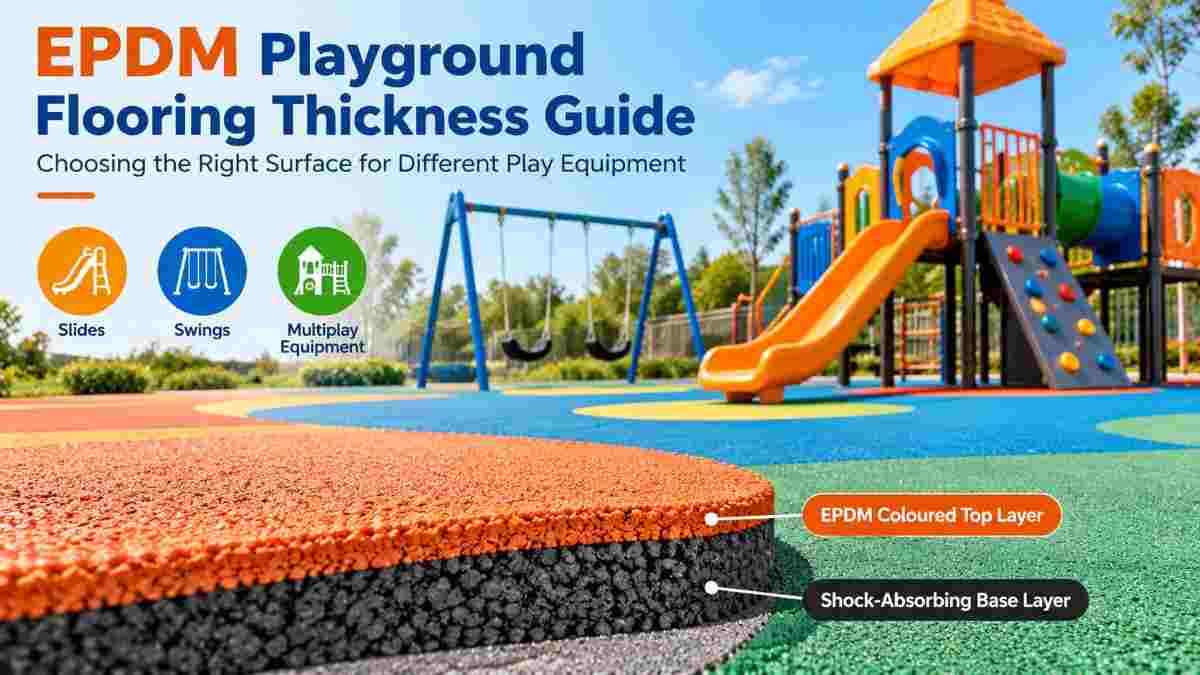
Are you planning a playground for a school, public park, residential community, or recreational facility? Choosing the right EPDM playground flooring thickness is an important part of creating a safer play environment. Playground surfacing needs to provide appropriate impact protection for the equipment installed above it, not simply create an attractive or colorful surface.
The correct EPDM playground flooring thickness depends on the equipment's fall height, the tested impact-absorbing performance of the complete flooring system, and the installation conditions. A surface suitable for a ground-level activity area may not provide adequate protection beneath an elevated climbing structure.
EPDM rubber flooring is commonly used in playgrounds because it can be installed as a durable, continuous surface with a range of colors, designs, and cushioning characteristics. However, different EPDM flooring systems offer different levels of impact protection.
G.N. Enterprises, a playground equipment manufacturer and supplier based in Jaipur, India, offers EPDM rubber flooring solutions for schools, parks, residential communities, and recreational projects.
This guide explains how to select EPDM flooring thickness, understand critical fall height, evaluate equipment requirements, and prepare for a professional playground flooring installation.
What Is the Recommended EPDM Playground Flooring Thickness?
There is no single recommended EPDM playground flooring thickness suitable for every playground. The required thickness depends on the fall height of the equipment and the independently tested impact-attenuation performance of the complete flooring system.
Different playgrounds may need different surfacing specifications because their equipment varies in height, design, and intended age group.
When selecting thickness, consider:
-
Equipment fall height: Determine the applicable fall height for each play structure.
-
Impact protection: Confirm the system's tested critical height rating.
-
Flooring construction: Identify the materials and thickness of each layer.
-
Substrate: Review the underlying concrete, asphalt, or engineered base.
-
Playground layout: Identify areas requiring impact-absorbing protection.
-
Installation conditions: Consider drainage, surface preparation, and curing requirements.
-
Maintenance: Understand how damage or wear could affect performance.
A flooring manufacturer or qualified installer should recommend a system supported by test documentation for the project's required fall height.
Explore the EPDM Rubber Flooring Solutions offered by G.N. Enterprises.
What Is EPDM Playground Flooring and How Does It Work?
EPDM playground flooring is a rubber-based surface system that can provide impact absorption, traction, and a continuous walking or playing surface. Playground installations commonly use EPDM granules in an upper wear layer, supported by a shock-absorbing rubber base layer.
EPDM stands for Ethylene Propylene Diene Monomer, a synthetic rubber known for its resistance to weathering and environmental exposure.
Poured-in-place playground flooring often includes two main layers.
What Is the EPDM Top Layer Used For?
The EPDM top layer provides the visible playing surface and contributes to wear resistance, traction, and the appearance of the playground.
This layer commonly uses colored EPDM rubber granules bonded with a suitable polyurethane binder.
Its main functions include:
-
Providing a finished walking and playing surface.
-
Supporting grip under appropriate conditions.
-
Allowing decorative patterns and color combinations.
-
Protecting the underlying rubber layer from everyday exposure.
-
Contributing to the overall flooring system's durability.
The thickness of the top layer should follow the tested system specification rather than an arbitrary design preference.
What Is the SBR Base Layer Used For?
The SBR base layer provides much of the cushioning and impact-absorbing performance in many poured-in-place playground flooring systems.
SBR stands for Styrene-Butadiene Rubber. The base layer is commonly manufactured using rubber granules combined with a suitable binder.
Its functions include:
-
Absorbing part of the energy generated during impacts.
-
Supporting the upper EPDM wear layer.
-
Helping the complete flooring system achieve its tested performance.
-
Providing the required installed system depth.
The appropriate SBR base thickness depends on the system's tested design and intended critical fall height.
Learn more about the available flooring construction through the G.N. Enterprises EPDM Rubber Flooring page.
What Is Critical Fall Height in Playground Flooring?
Critical fall height is the height rating established through impact testing of a playground surface under specified conditions. It is used to evaluate whether the surface provides appropriate head-impact attenuation for the fall height of the equipment installed above it.
The critical height of the protective surfacing should be at least as great as the applicable fall height of the playground equipment.
For example, if a playground structure has an applicable fall height of 1.5 meters, the selected surfacing system should have a documented critical height rating of at least 1.5 meters under the relevant test conditions.
This does not mean that every surface with the same nominal thickness will provide the same protection.
Critical height depends on the complete tested system, including:
-
Rubber material composition.
-
Layer thicknesses.
-
Granule properties.
-
Binder formulation.
-
Installation quality.
-
Underlying surface conditions.
-
Environmental conditions during testing.
The U.S. Consumer Product Safety Commission's Public Playground Safety Handbook recommends selecting protective surfacing based on its tested critical height relative to the equipment's fall height.
How Do You Determine the Fall Height of Playground Equipment?
Playground equipment fall height is determined according to the applicable safety standard and the type of equipment being evaluated. It generally represents the relevant vertical distance from a designated play surface or specified point on the equipment to the protective surface below.
Different types of equipment may require different measurement methods.
For example:
-
Elevated platforms may be evaluated using their designated play surface height.
-
Swings require an equipment-specific fall-height determination.
-
Climbing equipment may be assessed using the appropriate climbing or support surfaces.
-
Other specialized play structures may have additional measurement rules.
Do not assume that the overall equipment height or slide length equals the fall height.
Before ordering flooring, obtain the equipment manufacturer's fall-height information and confirm the measurement method under the applicable standard.
How Thick Should EPDM Flooring Be Under Playground Slides?
EPDM flooring beneath playground slides should have tested impact protection appropriate to the slide's applicable fall height and designated use zones. The correct thickness depends on the slide design, its platform height, and the tested flooring system.
Playground slides often include areas where children may lose balance or fall, especially near elevated access structures.
When selecting flooring for a slide area, check:
-
Platform height and equipment-specific fall height.
-
Exit and access areas.
-
Required protective surfacing zones.
-
Impact-test results for the proposed flooring.
-
Adequate drainage around the slide.
-
Safe transitions between the flooring and surrounding surfaces.
A low slide and a taller playground slide should not automatically receive the same flooring specification.
For school playground projects, ask the supplier to evaluate the slide and flooring as part of one coordinated installation.
How Thick Should EPDM Flooring Be Under Swings?
EPDM flooring under swings should be selected using the applicable swing fall-height requirements and an impact-tested surfacing system. Swing areas also require adequate front and rear use zones because children move dynamically while swinging.
Unlike a stationary climbing platform, a swing creates repeated movement and concentrated surface wear.
Important considerations include:
-
Swing type and dimensions.
-
Applicable fall-height calculation.
-
Front and rear protective use zones.
-
Impact-absorbing surface performance.
-
Surface wear below swing seats.
-
Drainage and water accumulation.
-
Maintenance and periodic inspection.
High-use swing areas may experience more concentrated wear than surrounding walkways.
Maintenance plans should include inspecting the surface for damage and changes that could affect impact protection.
What EPDM Flooring Thickness Is Suitable for Multiplay Systems?
EPDM flooring beneath a multiplay system should be specified according to the equipment's applicable fall height, protective use zones, and the tested performance of the proposed surface. Larger multiplay structures may include platforms, slides, climbing elements, and other activities with different safety requirements.
For these installations, the planning process should include:
-
Obtain the multiplay system's technical drawing.
-
Confirm the intended age group.
-
Identify the applicable fall heights.
-
Mark the required protective use zones.
-
Review the surface's tested critical height.
-
Select an appropriate flooring system.
-
Confirm installation and drainage requirements.
-
Arrange post-installation inspection and testing as required.
A single continuous flooring system may be designed to meet the highest relevant requirement, or different zones may be specified where appropriate and professionally designed.
G.N. Enterprises offers playground structures through its FRP Multiplay Systems and LLDPE Multiplay Systems product categories.
Does EPDM Flooring Thickness Depend on the Age of the Children?
EPDM flooring thickness is not determined by children's age alone. It must primarily be selected according to equipment fall height and the performance of the tested surface system.
However, age affects playground planning because younger and older children may use different equipment.
For preschool playgrounds, project owners should consider:
-
Age-appropriate play equipment.
-
Suitable access heights.
-
Appropriate protective surfacing.
-
Clear supervision areas.
-
Safe playground circulation.
-
Accessible play opportunities.
For elementary school playgrounds, buyers should evaluate the fall heights of climbing structures, slides, swings, and multiplay systems.
The required flooring specification must match the installed equipment rather than relying on a general preschool or school category.
Can You Use the Same EPDM Flooring Thickness Across an Entire Playground?
Yes, a playground can use the same EPDM flooring system across multiple areas if that system meets the applicable impact-protection requirements for all relevant equipment and locations. However, using one thickness everywhere is not automatically necessary or appropriate.
A playground may include:
-
Elevated play equipment areas.
-
Ground-level activity zones.
-
Walkways.
-
Seating areas.
-
Open recreational spaces.
These spaces may have different functional requirements.
An appropriate design can use a consistent surface where practical, but the protective areas must satisfy the relevant impact-attenuation criteria.
The final design should also prevent unsafe level changes, abrupt edges, and accessibility barriers.
How Does the Substrate Affect EPDM Playground Flooring Performance?
The substrate affects EPDM playground flooring because it supports the rubber system and influences drainage, stability, and installation quality. The complete flooring system must be appropriate for the underlying surface.
Common substrate considerations include:
Concrete, asphalt, or specially engineered bases may be suitable for particular poured-in-place systems when properly designed and prepared.
However, hard surfaces alone are not adequate protective surfacing beneath elevated playground equipment.
The installed rubber system must provide the appropriate tested impact attenuation.
Why Is Drainage Important for EPDM Playground Flooring?
Proper drainage helps reduce standing water, protects the flooring system, and supports safer playground use. Inadequate drainage can contribute to water accumulation, maintenance problems, and deterioration of certain surfacing systems.
Before installation, check:
-
Site drainage patterns.
-
Surface slopes.
-
Water outlets.
-
Substrate permeability.
-
Compatibility with the flooring design.
-
Nearby landscaping and irrigation.
-
Potential water accumulation after rainfall.
Drainage requirements may differ between permeable and impermeable surfacing systems.
In regions experiencing heavy seasonal rainfall, careful drainage planning is especially important.
The installer should explain how the proposed EPDM system will handle water on the specific site.
Does Thicker EPDM Flooring Always Provide Better Safety?
No. Thicker EPDM flooring does not automatically provide better or adequate safety performance. Impact protection depends on the complete system's tested construction, material properties, and installation quality.
For example, two flooring systems with the same overall thickness may perform differently because they use different rubber granules, binders, base-layer compositions, or installation methods.
Likewise, increasing the thickness of one component without following a tested design does not establish a new certified fall-height rating.
Buyers should request:
-
Tested critical height information.
-
Total installed system thickness.
-
Thickness of individual layers.
-
Material composition.
-
Applicable laboratory test reports.
-
Installation requirements.
-
Field verification details.
Select flooring using verified impact performance rather than thickness alone.
What Playground Flooring Safety Standards Should Buyers Check?
Buyers should check the playground surfacing standards applicable to their project's location, equipment, and procurement requirements. For projects referencing US standards, ASTM F1292 is used for laboratory impact-attenuation evaluation, while ASTM F3313 addresses field impact testing of installed surfaces.
Important standards and guidance include:
-
ASTM F1292: Addresses impact attenuation of surfacing materials within playground equipment use zones.
-
ASTM F3313: Provides a method for evaluating installed playground surfacing in the field.
-
ASTM F1951: Addresses accessibility-related performance of surface systems.
-
CPSC Public Playground Safety Handbook: Provides playground safety recommendations, including protective surfacing guidance.
Schools and playground buyers in India should also check applicable Bureau of Indian Standards requirements, local regulations, and project-specific specifications.
For additional reference, review the CPSC Playground Surfacing Standards.
A supplier's general quality claims should not be treated as proof that a particular flooring installation meets every applicable standard.
How Can You Check the Quality of EPDM Flooring Before Installation?
Before installing EPDM playground flooring, review the proposed material specifications, sample quality, binder system, layer construction, impact-testing documentation, and substrate preparation requirements.
A practical pre-installation checklist includes:
-
EPDM granules: Confirm the specified quality, size, and color.
-
SBR base layer: Review the proposed cushioning system.
-
Binder: Confirm suitability for the selected installation method.
-
Thickness: Check the total and individual layer specifications.
-
Testing: Request relevant impact-attenuation reports.
-
Substrate: Confirm site preparation requirements.
-
Drainage: Review the water management design.
-
Finishing: Discuss transitions, edges, and accessibility.
-
Installation: Confirm curing requirements and inspection procedures.
These checks help establish clear expectations between the project owner and flooring supplier.
What Should You Inspect After EPDM Playground Flooring Installation?
After EPDM flooring installation, inspect the finished surface for consistent construction, secure edges, appropriate drainage, visible defects, and the required impact performance. The installer should provide relevant documentation confirming the work matches the approved specification.
A useful handover checklist includes:
-
Review the completed flooring layout.
-
Check edges and transitions.
-
Inspect for cracks, gaps, or loose granules.
-
Review surface smoothness and drainage.
-
Confirm the installed system and layer thicknesses.
-
Check accessibility at required routes.
-
Obtain applicable field impact-testing results.
-
Request cleaning and maintenance instructions.
-
Record inspection findings before accepting the project.
A visual inspection alone cannot establish compliance with fall-impact requirements.
Where applicable, field testing should be completed using the relevant standard and appropriate testing personnel.
How Should EPDM Playground Flooring Be Maintained?
EPDM playground flooring should be maintained through routine cleaning, periodic inspections, prompt repairs, and monitoring of impact performance where required. The maintenance frequency depends on usage, environmental conditions, and manufacturer guidance.
Recommended maintenance activities include:
-
Removing debris and accumulated dirt.
-
Cleaning with approved products.
-
Checking for damaged edges.
-
Inspecting cracks or surface separation.
-
Monitoring high-traffic areas.
-
Reviewing drainage after heavy rain.
-
Repairing damaged sections appropriately.
-
Keeping records of inspections and maintenance.
Avoid using harsh chemicals or unsuitable cleaning equipment that could damage the surface.
High-use public playgrounds may require more frequent inspections than lightly used facilities.
What Factors Affect the Cost of EPDM Playground Flooring?
EPDM playground flooring costs depend on the total installation area, required system thickness, materials, impact-performance requirements, site preparation, design complexity, and installation conditions.
Important cost factors include:
-
Total surface area.
-
Required fall-height protection.
-
EPDM wear-layer specification.
-
SBR cushioning-layer thickness.
-
Binder and material requirements.
-
Site preparation.
-
Drainage work.
-
Custom colors and patterns.
-
Edge finishing.
-
Transportation and labor.
-
Inspection and testing requirements.
Buyers should request an itemized quotation that identifies the specified flooring system and its installation requirements.
A lower price per square foot does not necessarily mean the proposed surface offers equivalent impact protection.
Why Should Schools and Parks Consider G.N. Enterprises for EPDM Rubber Flooring?
G.N. Enterprises supplies EPDM rubber flooring solutions for playgrounds, schools, parks, residential communities, and recreational areas. Its product offering includes poured-in-place flooring systems with customizable thicknesses, colors, and patterns.
Based in Jaipur, Rajasthan, the company also supplies playground equipment and multiplay systems.
Its EPDM flooring page describes:
-
Dual-layer rubber surfacing construction.
-
EPDM wear layers.
-
SBR cushioning layers.
-
Custom flooring thickness options.
-
Decorative color and pattern choices.
-
Site and equipment-related flooring assessments.
-
Installation support.
-
Maintenance guidance.
The company lists a typical customizable thickness range of 10 mm to 100 mm, but this is a product range, not a universal safe-thickness recommendation. The required thickness must be determined using the specific installation's fall-height requirements and tested surfacing performance.
Visit the G.N. Enterprises EPDM Rubber Flooring page to review available options.
What Information Should You Share When Requesting an EPDM Flooring Quotation?
An EPDM playground flooring quotation request should include the site dimensions, equipment details, applicable fall heights, substrate conditions, drainage requirements, and preferred surface design. These details help the supplier evaluate the project and propose a suitable system.
Include:
-
Project type: School, park, residential community, or recreational area.
-
Location: City and installation address.
-
Flooring area: Total dimensions and approximate square footage.
-
Equipment: Types of playground equipment being installed.
-
Fall heights: Manufacturer-provided information for each structure.
-
Existing surface: Concrete, asphalt, or another substrate.
-
Drainage: Known site conditions and water management requirements.
-
Colors: Preferred EPDM colors or patterns.
-
Installation: New construction or replacement flooring.
-
Safety: Applicable standards and testing requirements.
-
Timeline: Expected project schedule.
Provide site photographs and a playground layout drawing where available.
What Are the Most Frequently Asked Questions About EPDM Playground Flooring Thickness?
The most common questions concern minimum thickness, critical fall height, installation materials, drainage, maintenance, and suitability for different playground equipment. The answers below address these questions directly.
Is 20 mm EPDM Flooring Suitable for a Playground?
A 20 mm EPDM flooring system may be suitable for certain applications, but it should not be assumed to provide adequate fall protection beneath elevated playground equipment. Its suitability depends on the tested critical height and the equipment's fall height.
Is 40 mm EPDM Flooring Better Than 20 mm Flooring?
A thicker system may provide greater impact attenuation when other construction factors are comparable, but 40 mm flooring is not automatically safer than 20 mm flooring. Buyers must compare tested critical height ratings.
What Is the Best EPDM Flooring Thickness for School Playgrounds?
The best thickness is the one specified by a tested surfacing system that meets the applicable fall-height and installation requirements. Schools should obtain recommendations based on their actual equipment.
Can EPDM Flooring Be Installed Over Concrete?
Yes. Certain poured-in-place EPDM systems are designed for installation over properly prepared concrete. However, the complete surfacing system must provide appropriate impact protection, and the concrete base must meet installation requirements.
Does EPDM Flooring Prevent Playground Injuries?
No. Impact-absorbing playground flooring can reduce the likelihood of certain serious injuries from falls, but it cannot prevent every injury or eliminate playground risks.
Is EPDM Rubber Flooring Suitable for Outdoor Parks?
Yes. Appropriately formulated EPDM flooring systems can be used in outdoor parks. Material suitability, drainage, UV resistance, installation quality, and maintenance should be evaluated for each project.
Can EPDM Flooring Be Installed Around Slides and Swings?
Yes. EPDM flooring can be installed around slides and swings when the selected system provides the required impact protection and the protective use zones are correctly designed.
Does EPDM Flooring Require Regular Maintenance?
Yes. Regular cleaning, inspections, and prompt repairs help maintain the condition of the flooring. Additional impact testing may be appropriate under applicable standards or maintenance programs.
How Long Does EPDM Playground Flooring Last?
Service life depends on the flooring materials, environmental exposure, installation quality, usage, and maintenance. Buyers should request product-specific durability information and warranty terms rather than assuming a guaranteed lifespan.
Can EPDM Flooring Be Customized With Different Colors?
Yes. EPDM playground flooring can be produced in different colors and patterns, depending on the supplier's available materials and installation capabilities.
How Can You Request EPDM Playground Flooring Installation and Pricing From G.N. Enterprises?
You can request EPDM playground flooring pricing from G.N. Enterprises by sharing your site dimensions, playground equipment information, fall-height requirements, and preferred flooring design. The company can review your requirements and discuss suitable materials and installation arrangements.
Whether you are developing a school playground, renovating a public park, or planning a residential community play area, choosing the appropriate impact-tested flooring system is an important part of the overall project.
Looking for EPDM rubber flooring manufacturers in India?
Explore G.N. Enterprises EPDM Rubber Flooring Solutions or contact G.N. Enterprises to discuss your playground flooring requirements and request a quotation.