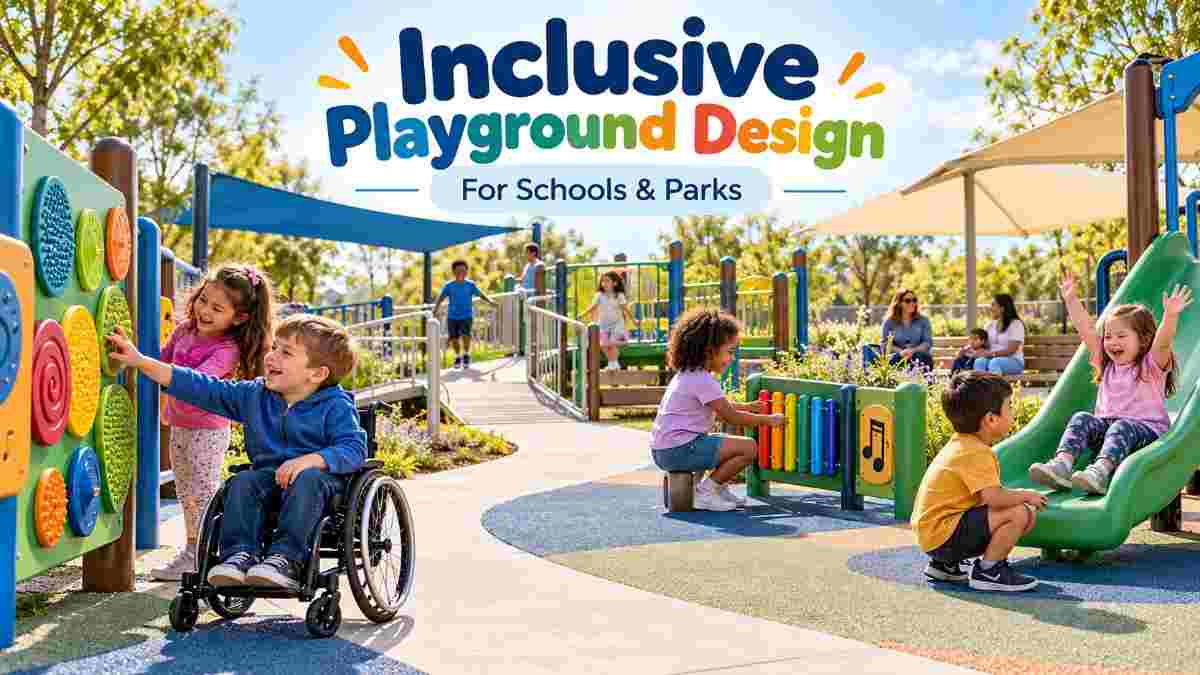
Are you planning a school playground, public park, or residential play area where children with different physical, sensory, and developmental abilities can play together? Creating an inclusive playground design involves more than installing colorful slides and swings. It requires thoughtful planning to make play activities, pathways, seating, and gathering spaces usable by a wider range of children.
An inclusive playground is an outdoor play environment designed to help children of different abilities participate, interact, and enjoy age-appropriate activities together. It combines accessible routes, varied play experiences, suitable equipment, protective surfacing, and thoughtful layouts that reduce unnecessary barriers.
For schools, parks, residential communities, and recreational facilities, inclusive design can make playgrounds more welcoming to children and caregivers with different mobility and sensory needs.
G.N. Enterprises manufactures and supplies outdoor playground equipment, including school playground structures, slides, multiplay systems, and playground flooring products.
This guide explains how to plan an inclusive playground, evaluate equipment, design accessible pathways, and choose suitable flooring for a school or public recreation project.
What Is an Inclusive Playground Design?
Inclusive playground design is an approach to creating play environments where children with different abilities can access and participate in a variety of activities together. It considers physical accessibility, sensory preferences, social interaction, age suitability, and overall playground safety.
An inclusive playground may include:
-
Accessible routes connecting important play areas.
-
Ground-level interactive play components.
-
Activities suitable for different physical abilities.
-
Sensory play opportunities.
-
Spaces for independent and cooperative play.
-
Comfortable seating and caregiver areas.
-
Appropriate impact-absorbing playground surfacing.
-
Clear circulation and accessible entrances.
An inclusive playground does not require every child to use every piece of equipment in exactly the same way. Instead, it should provide meaningful choices and opportunities for children to participate together.
Why Is Inclusive Playground Design Important for Schools and Public Parks?
Inclusive playground design helps reduce participation barriers and creates more opportunities for children of different abilities to interact, explore, and play together. It also considers caregivers and visitors who may need accessible pathways and seating.
Playgrounds support several areas of childhood development, including:
-
Physical activity: Opportunities for movement, balance, climbing, and coordination.
-
Social interaction: Shared activities and cooperative play.
-
Sensory exploration: Experiences involving touch, sound, movement, and visual elements.
-
Problem-solving: Activities that encourage experimentation and decision-making.
-
Independent play: Opportunities for children to make choices and explore at their own pace.
An accessible route alone does not guarantee meaningful inclusion. The playground should also offer play experiences children can actually reach and use.
What Is the Difference Between an Accessible Playground and an Inclusive Playground?
An accessible playground focuses on removing physical barriers and meeting applicable accessibility requirements, while an inclusive playground goes further by considering participation, social interaction, sensory needs, and varied play experiences.
Accessibility is an essential part of inclusion, but it is not the entire design process.
An accessible playground may provide:
-
Step-free entry.
-
Suitable pathways.
-
Access to designated play components.
-
Appropriate maneuvering spaces.
-
Accessible seating or supporting facilities.
An inclusive playground also considers:
-
Whether children can play alongside one another.
-
Whether activities offer different levels of challenge.
-
Whether sensory experiences are varied.
-
Whether children can participate without unnecessary separation.
-
Whether caregivers can comfortably supervise and assist.
A successful design should address both accessibility and meaningful participation.
How Should Schools Plan an Inclusive Playground Layout?
Schools should plan an inclusive playground by assessing the available space, student age groups, accessibility needs, play activities, safety requirements, and supervision arrangements before selecting equipment.
A practical planning process includes:
-
Identify user groups: Consider the ages and different abilities of children expected to use the playground.
-
Measure the site: Record the available area, existing slopes, access points, and obstacles.
-
Plan accessible circulation: Connect entrances, play zones, seating, and other important facilities.
-
Select varied activities: Include physical, sensory, imaginative, and social play opportunities.
-
Review safety: Check equipment use zones, fall heights, and protective surfacing.
-
Consider supervision: Maintain suitable visibility across the playground.
-
Review maintenance: Plan for inspections, cleaning, and repairs.
-
Seek user feedback: Involve children, caregivers, educators, and accessibility professionals.
Schools can explore the School Playground Equipment Collection from G.N. Enterprises while planning suitable equipment options.
What Types of Equipment Can Be Included in an Inclusive Playground?
Inclusive playgrounds can include ground-level activity panels, suitable slides, accessible play structures, sensory features, swings, and cooperative play equipment. The final selection should provide varied experiences while meeting the site's safety and accessibility requirements.
How Can Ground-Level Play Equipment Improve Accessibility?
Ground-level play equipment allows children to approach activities without necessarily climbing an elevated structure.
Examples may include:
-
Interactive play panels.
-
Musical activity panels.
-
Sensory exploration stations.
-
Accessible activity tables.
-
Ground-level imaginative play features.
-
Cooperative games.
Ground-level activities should be positioned along accessible routes with appropriate maneuvering space.
How Can Slides Be Included in an Inclusive Playground?
Slides can be included in inclusive playgrounds when their access, platform design, landing areas, and protective surfacing meet the applicable requirements.
Depending on the design, some children may use steps, transfer systems, or accessible approaches to reach certain slide components.
However, a slide should not be described as wheelchair accessible simply because it is located near an accessible pathway.
The complete equipment configuration must be evaluated.
How Can Swings Support Inclusive Play?
Swings can support inclusive play when the playground offers suitable swing types and access arrangements for the intended users.
Potential considerations include:
-
Appropriate seat support.
-
Suitable transfer arrangements where applicable.
-
Clear access routes.
-
Safe swing use zones.
-
Age and weight suitability.
-
Caregiver assistance requirements.
Specialized swing designs should be selected using manufacturer specifications and applicable safety guidance.
How Can Multiplay Systems Be Included in Accessible Playgrounds?
Multiplay systems can contribute to inclusive playground design when accessible components and meaningful ground-level activities are integrated into the overall layout.
A multiplay structure may include slides, platforms, activity panels, bridges, and climbing elements.
Not every conventional multiplay system is accessible. Buyers should verify the specific design, access methods, and available play components rather than assuming accessibility based on the product category.
How Do You Design Wheelchair-Accessible Routes in a Playground?
Wheelchair-accessible playground routes should provide a continuous, stable, usable path connecting the playground entrance to required accessible play components and supporting facilities. Route dimensions, slopes, turning spaces, and surface characteristics should follow the accessibility requirements applicable to the project.
Important design considerations include:
-
Adequate clear route width.
-
Suitable running and cross slopes.
-
Firm and stable surfacing.
-
Appropriate turning spaces.
-
Accessible transitions.
-
Clear access to play components.
-
Routes free from unnecessary obstructions.
For reference, the U.S. ADA play-area provisions generally specify a minimum clear width of 60 inches for ground-level accessible routes, with certain exceptions for specific conditions.
These US requirements should not be assumed to apply automatically to Indian projects. Local regulations, applicable Indian accessibility standards, and project-specific requirements must be checked.
The U.S. Access Board's Play Area Accessibility Guidance provides detailed technical information for projects using ADA standards.
Why Are Ground-Level Play Activities Important in Inclusive Playgrounds?
Ground-level play activities are important because they can provide accessible and meaningful play opportunities without requiring children to reach elevated platforms. They may also support interaction among children using different mobility devices or requiring different levels of physical assistance.
Useful ground-level experiences include:
-
Musical play.
-
Tactile exploration.
-
Imaginative play.
-
Cooperative games.
-
Interactive panels.
-
Sensory activities.
-
Accessible play tables.
However, simply placing all accessible equipment in one isolated corner does not create an inclusive playground.
Activities should be integrated across the play environment so children can participate together.
How Can Sensory Play Areas Make Playgrounds More Inclusive?
Sensory play areas make playgrounds more inclusive by offering activities involving touch, sound, movement, and visual exploration, while allowing children to choose experiences that suit their preferences.
Children can have different sensory needs. Some enjoy active, stimulating environments, while others may benefit from quieter activities.
Potential sensory features include:
-
Tactile panels with different textures.
-
Musical play components.
-
Interactive visual elements.
-
Movement-based play activities.
-
Nature-inspired exploration areas.
-
Quiet seating spaces.
-
Imaginative play stations.
Avoid assuming that one sensory feature is suitable for every child.
A thoughtful playground provides choices rather than requiring all children to engage with the same level of stimulation.
Should Inclusive Playgrounds Include Quiet Spaces?
Yes. Quiet spaces can be useful in inclusive playgrounds because they provide an alternative to busy or highly stimulating play areas. These spaces may support children who need a short break from noise, activity, or sensory input.
A quiet area may include:
-
Comfortable seating.
-
Partial shade.
-
Visual separation from busy play zones.
-
Clear caregiver visibility.
-
A simple, uncluttered layout.
-
Accessible pathways.
Quiet spaces should remain part of the overall playground environment rather than becoming isolated or difficult to supervise.
What Is the Best Playground Flooring for Inclusive Play Areas?
The best flooring for an inclusive playground is a surface that satisfies applicable accessibility requirements while providing appropriate impact protection beneath playground equipment. Material selection should be based on documented performance rather than appearance alone.
Important factors include:
-
Surface firmness and stability.
-
Accessibility for mobility devices.
-
Impact attenuation.
-
Equipment fall height.
-
Slip resistance.
-
Drainage.
-
Maintenance needs.
-
Installation quality.
-
Changes in surface level.
Certain poured-in-place rubber flooring systems may support accessible playground design when properly specified and installed.
However, not every rubber surface automatically meets accessibility or fall-impact requirements.
Can EPDM Rubber Flooring Be Used in Inclusive Playgrounds?
Yes. EPDM rubber flooring can be used as part of an inclusive playground when the complete surfacing system meets the required impact-protection, accessibility, and installation criteria.
Poured-in-place rubber systems commonly combine a colored EPDM wear layer with an impact-absorbing base.
Buyers should verify the actual system's performance.
Explore EPDM Rubber Flooring for Playgrounds from G.N. Enterprises.
Does Playground Flooring Thickness Affect Accessibility?
Flooring thickness primarily relates to the construction and impact performance of the selected system, while accessibility also depends on firmness, stability, slope, transitions, and surface conditions.
A thicker surface is not automatically more accessible or safer.
The complete installed flooring system must be evaluated against the relevant requirements.
How Can Inclusive Playground Design Improve Social Interaction?
Inclusive playground design can encourage social interaction by providing shared activities that children of different abilities can approach and participate in together. Equipment placement and activity variety influence whether children can play alongside one another.
Useful design approaches include:
-
Creating cooperative play stations.
-
Positioning accessible activities near other play experiences.
-
Providing space for multiple participants.
-
Including imaginative group activities.
-
Avoiding separate zones that unnecessarily divide children.
-
Offering activities with different levels of difficulty.
For example, a ground-level musical panel positioned near other interactive features may create opportunities for children to participate together.
Playground layouts should encourage shared experiences while respecting individual preferences.
How Should Public Parks Plan Inclusive Playgrounds for Different Age Groups?
Public parks should plan inclusive playgrounds by considering both age-appropriate equipment and the accessibility needs of children who may use different areas. Younger and older children often require different play experiences, equipment dimensions, and supervision arrangements.
For younger children, consider:
-
Low-level activities.
-
Age-appropriate slides.
-
Sensory panels.
-
Imaginative play.
-
Easy-to-reach features.
For older children, consider:
-
Age-appropriate climbing activities.
-
Cooperative play challenges.
-
More complex interactive activities.
-
Suitable multiplay equipment.
-
Activities offering different levels of physical challenge.
Accessible routes should connect the relevant play areas, and caregivers should be able to supervise children effectively.
What Safety Standards Should Be Considered for Inclusive Playground Design?
Inclusive playground design should account for both playground safety standards and the accessibility requirements applicable to the project. Equipment selection, surfacing, spacing, installation, and maintenance all contribute to a safer play environment.
Relevant considerations include:
For international reference, the CPSC Public Playground Safety Handbook provides playground safety recommendations.
The U.S. Access Board's Accessibility Standards provide technical requirements for covered US play areas.
For playground projects in India, designers should confirm applicable Indian standards, accessibility requirements, and local regulations rather than assuming US rules apply directly.
How Can Schools Make an Existing Playground More Inclusive?
Schools can improve an existing playground by identifying accessibility barriers, reviewing available play experiences, and introducing appropriate modifications that provide more opportunities for children to participate.
Potential improvements include:
-
Assess existing entrances and pathways.
-
Identify inaccessible equipment and play zones.
-
Review surface conditions.
-
Add suitable ground-level activities.
-
Improve seating and supervision areas.
-
Consider sensory play features.
-
Review equipment age suitability.
-
Consult accessibility and playground safety professionals.
-
Verify that modifications do not create new hazards.
Major changes to playground equipment or surfacing should be evaluated by qualified professionals.
Adding one accessible component is a useful step, but meaningful inclusion requires considering the entire playground experience.
What Should Schools and Developers Check Before Buying Inclusive Playground Equipment?
Before buying inclusive playground equipment, project owners should review accessibility features, age suitability, equipment dimensions, safety documentation, surfacing requirements, installation arrangements, and maintenance needs.
Use this purchasing checklist:
-
Project users: Identify intended age groups and access requirements.
-
Site dimensions: Share the available playground area.
-
Equipment: Request detailed product descriptions and drawings.
-
Accessibility: Confirm how accessible routes connect to play components.
-
Ground-level play: Check the variety of available experiences.
-
Safety: Review use zones, fall heights, and equipment specifications.
-
Surfacing: Confirm accessibility and impact performance.
-
Installation: Obtain foundation and site requirements.
-
Documentation: Request relevant technical information.
-
Maintenance: Confirm inspection procedures and spare-part availability.
Buyers should not assume every standard playground product is suitable for an inclusive installation.
Why Should Schools Consider G.N. Enterprises for Playground Equipment Planning?
G.N. Enterprises offers playground equipment, school play structures, multiplay systems, and rubber flooring products that can be evaluated as part of a school or public playground project.
Based in Jaipur, Rajasthan, India, the company supplies several categories of playground and outdoor recreation equipment.
Its product range includes:
-
School playground equipment.
-
Outdoor multiplay systems.
-
Playground slides.
-
Children's play structures.
-
Rubber playground flooring.
-
Other outdoor recreational products.
The company does not need to be assumed to offer certified inclusive equipment in every category. Buyers should request product-specific accessibility and safety information for any proposed inclusive installation.
Explore the School Playground Equipment Collection and EPDM Rubber Flooring Solutions to review available products.
What Information Should You Share When Requesting an Inclusive Playground Quotation?
An inclusive playground quotation request should include the site dimensions, intended age groups, accessibility objectives, preferred equipment, flooring requirements, and project location. Providing these details helps the supplier understand the proposed installation.
Include:
-
Project type: School, public park, residential community, or recreational facility.
-
Location: City and project site.
-
Site dimensions: Available playground area and layout.
-
Users: Intended age groups and accessibility needs.
-
Equipment: Preferred slides, multiplay structures, and ground-level activities.
-
Surfacing: Existing ground conditions and flooring requirements.
-
Access: Entrances, pathways, slopes, and other barriers.
-
Facilities: Seating, shade, and supporting amenities.
-
Safety: Applicable design standards and project specifications.
-
Budget: Approximate project budget, if available.
-
Timeline: Preferred installation schedule.
Site photographs and layout drawings can also support project discussions.
What Are the Most Frequently Asked Questions About Inclusive Playground Design?
Common questions about inclusive playgrounds concern accessibility, wheelchair access, sensory activities, surfacing, equipment selection, and the feasibility of adapting existing spaces.
What Makes a Playground Inclusive?
An inclusive playground combines accessible routes, varied play activities, appropriate surfacing, and opportunities for children of different abilities to interact and participate together.
Is an Accessible Playground the Same as an Inclusive Playground?
No. Accessibility primarily addresses the removal of barriers and compliance with relevant requirements, while inclusion also considers participation, social interaction, sensory experiences, and meaningful play choices.
Can Children Using Wheelchairs Participate in Playground Activities?
Yes. Appropriately designed accessible playgrounds can provide activities that children using wheelchairs can reach and use. The level of access depends on the specific equipment and site design.
Are Ground-Level Play Activities Important for Accessibility?
Yes. Ground-level activities can provide play opportunities without requiring access to elevated platforms and can encourage shared participation.
Is EPDM Rubber Flooring Suitable for Inclusive Playgrounds?
Yes, when the complete flooring system meets the relevant accessibility and impact-attenuation requirements. The material name alone does not establish compliance.
Do Inclusive Playgrounds Need Sensory Equipment?
Sensory features are valuable design options that can provide varied experiences. Their selection should reflect user needs, accessibility, safety, and the overall playground plan.
Can an Existing School Playground Be Modified for Better Accessibility?
Yes. Existing playgrounds may be improved through pathway upgrades, appropriate surfacing, added ground-level activities, and other modifications. A professional assessment should determine what is feasible.
Are Inclusive Playgrounds Only for Children With Disabilities?
No. Inclusive playgrounds are designed to support participation by children with a broad range of abilities, including children with and without disabilities.
Can Small Playgrounds Be Designed Inclusively?
Yes. Small playgrounds can incorporate accessible routes, meaningful ground-level activities, and thoughtful layouts, although available space affects equipment selection and circulation.
How Much Does Inclusive Playground Equipment Cost?
Costs depend on equipment types, accessibility features, surfacing, site preparation, installation, and project size. An accurate quotation requires project-specific specifications.
How Can You Plan an Inclusive School or Public Playground With G.N. Enterprises?
You can begin planning an inclusive playground project by sharing your site dimensions, intended users, equipment preferences, accessibility goals, and flooring requirements with G.N. Enterprises. The company can provide information about available playground equipment and surfacing options.
Before finalizing a project, have the proposed design reviewed against applicable accessibility, equipment safety, and installation requirements.
Whether you are developing a new school playground, renovating a community park, or planning a residential play area, a well-designed environment should offer safe, accessible, and meaningful play opportunities for a wider range of children.
Planning a new school or public playground?
Explore G.N. Enterprises School Playground Equipment, review the EPDM Rubber Flooring Collection, or contact G.N. Enterprises for a project quotation.