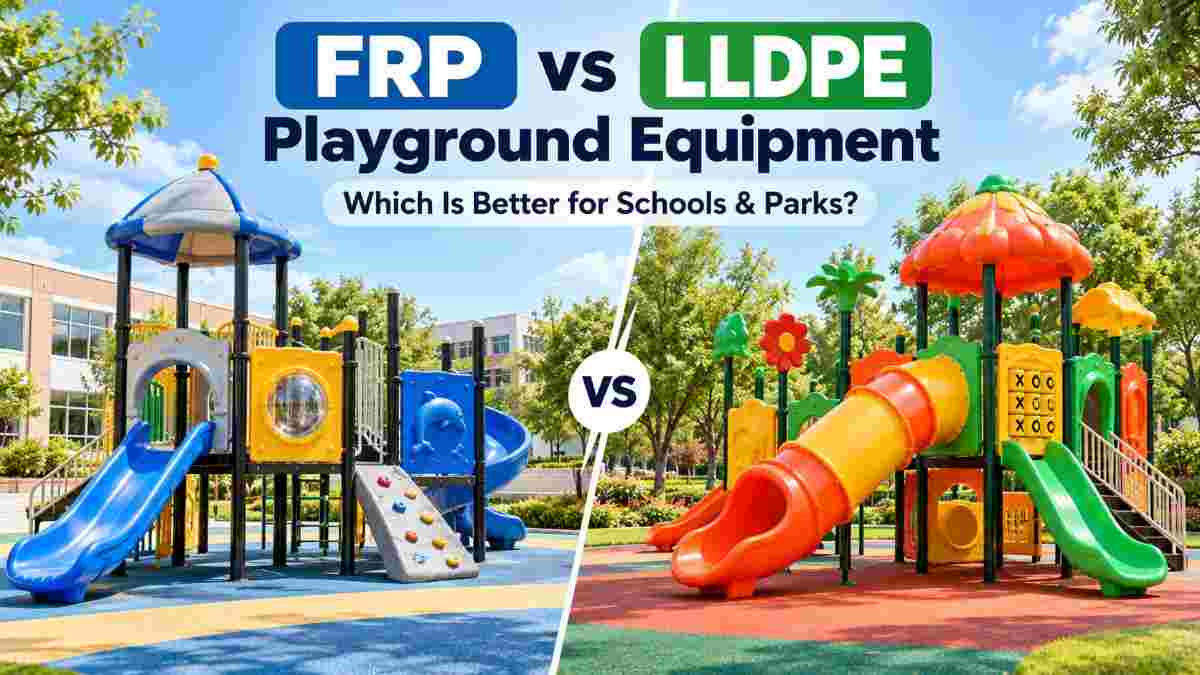
Are you planning to install new playground equipment at a school, public park, residential community, or commercial play area? One of the most important decisions is choosing the right material for slides, climbing structures, and multiplay systems. Two commonly used materials are FRP (Fiber Reinforced Plastic) and LLDPE (Linear Low-Density Polyethylene).
The main difference between FRP and LLDPE playground equipment is their construction. FRP is a composite material reinforced with fibers, while LLDPE is a thermoplastic material commonly shaped through rotational molding. Both can be suitable for outdoor playgrounds when the equipment is properly designed, manufactured, installed, and maintained.
Choosing between these materials requires evaluating durability, safety, weather resistance, maintenance, design flexibility, and overall project costs.
G.N. Enterprises manufactures and supplies outdoor playground equipment, including FRP and LLDPE multiplay systems, for schools, parks, residential developments, and other recreational spaces.
This guide explains the differences between FRP and LLDPE playground equipment to help buyers make informed purchasing decisions.
What Is the Main Difference Between FRP and LLDPE Playground Equipment?
FRP playground equipment is made from fiber-reinforced composite materials, while LLDPE playground equipment uses polyethylene-based plastic components. Their different manufacturing processes influence surface finish, rigidity, impact behavior, design possibilities, and maintenance requirements.
FRP and LLDPE are both used in outdoor playground construction, but their characteristics differ.
FRP playground equipment commonly offers:
-
Fiber-reinforced composite construction.
-
Rigid molded components.
-
Various colors and surface finishes.
-
Custom shapes for slides and play structures.
-
Options for repairing certain surface defects, depending on the damage.
-
Performance that depends on the resin, reinforcement, and protective coating.
LLDPE playground equipment commonly offers:
-
Rotationally molded plastic components.
-
Good impact resistance when suitable grades are used.
-
Smooth, rounded molded shapes.
-
Flexible design possibilities.
-
UV-stabilized material options.
-
Relatively simple routine surface cleaning.
Neither material is automatically superior in every application. Buyers should compare the complete equipment specifications rather than choosing based only on material names.
Explore the FRP Multiplay Systems and LLDPE Multiplay Systems available from G.N. Enterprises.
What Is FRP Playground Equipment and How Is It Manufactured?
FRP playground equipment is manufactured using a composite material consisting of a polymer resin reinforced with fibers, commonly glass fibers. This construction can produce rigid components suitable for certain playground slides, panels, and structural designs.
The manufacturing process generally involves preparing a mold, applying suitable reinforcement and resin, and allowing the composite to cure.
A protective surface finish may be used to improve appearance and weather resistance.
What Are the Main Benefits of FRP Playground Equipment?
FRP playground equipment can offer rigid construction, molded design flexibility, and a variety of surface finishes when manufactured using suitable materials and processes.
Potential benefits include:
-
Rigid components: Suitable for certain slide and panel designs.
-
Design flexibility: Molded shapes can accommodate different playground layouts.
-
Surface finishing: Protective coatings can provide attractive colors and finishes.
-
Repair possibilities: Some surface damage may be repairable by qualified professionals.
-
Custom manufacturing: Certain designs can be produced using specialized molds.
However, FRP components must be inspected for cracks, exposed fibers, coating deterioration, and other damage.
Where Is FRP Playground Equipment Commonly Used?
FRP components are commonly found in playground slides, activity structures, climbing features, and multiplay systems.
Potential applications include:
Buyers considering these products can browse the FRP Multiplay System Collection.
What Is LLDPE Playground Equipment and How Is It Manufactured?
LLDPE playground equipment is commonly manufactured using rotational molding, a process that creates hollow plastic components with smooth, integrated shapes. Suitable LLDPE grades can provide impact resistance, toughness, and outdoor weathering performance.
During rotational molding, polyethylene material is heated inside a rotating mold until it forms the required component.
The finished parts can be used to manufacture slides, tunnels, panels, and other playground features.
What Are the Main Benefits of LLDPE Playground Equipment?
LLDPE playground equipment can provide impact-resistant components, smooth molded surfaces, and flexible design options when appropriate material grades and manufacturing processes are used.
Potential advantages include:
-
Impact resistance: Suitable formulations can tolerate everyday impacts.
-
Smooth construction: Rotational molding allows rounded component shapes.
-
Color options: Pigments can be incorporated into the molding material.
-
Outdoor applications: UV-stabilized grades are available for exterior use.
-
Routine cleaning: Many molded surfaces are relatively easy to wash.
-
Design variety: Suitable for slides, tunnels, panels, and integrated play structures.
Actual performance depends on the resin grade, wall thickness, UV stabilization, installation, and expected usage.
Where Is LLDPE Playground Equipment Commonly Used?
LLDPE components are commonly used in outdoor multiplay systems, playground slides, tunnels, and other molded play structures.
Potential installation locations include:
Explore the LLDPE Multiplay Systems offered by G.N. Enterprises.
Which Is More Durable: FRP or LLDPE Playground Equipment?
Both FRP and LLDPE playground equipment can provide long-term outdoor service when properly specified, manufactured, installed, and maintained. Their durability depends on construction quality, environmental exposure, material formulation, and usage conditions.
FRP components are generally rigid, but deterioration of their protective coating or composite structure can affect performance.
LLDPE components can provide good impact resistance, but inadequate UV stabilization, excessive loading, or unsuitable design may contribute to deterioration.
When comparing durability, consider:
-
Material grade and manufacturing quality.
-
Expected daily playground usage.
-
Resistance to UV exposure.
-
Impact and load requirements.
-
Surface wear and abrasion.
-
Connection and fastening quality.
-
Inspection and maintenance procedures.
-
Availability of replacement components.
For heavily used public playgrounds, request product-specific technical specifications and relevant testing information.
Which Playground Material Performs Better in Hot Weather and Direct Sunlight?
Both FRP and UV-stabilized LLDPE can be used in outdoor environments, but neither material should be assumed to remain cool or unaffected by direct sunlight. Surface temperature, weathering, and durability depend on material formulation, color, exposure, and installation conditions.
Dark-colored playground surfaces may become uncomfortable or hazardous during periods of intense sunshine.
For playgrounds in hot Indian climates, buyers should evaluate:
-
UV resistance of the materials.
-
Surface temperature under direct sunlight.
-
Color and finish.
-
Availability of shade.
-
Heat-related expansion or deformation.
-
Inspection requirements.
-
Manufacturer maintenance recommendations.
Does FRP Playground Equipment Resist UV Exposure?
FRP playground components can be manufactured with protective surface systems designed to resist UV exposure and weathering.
However, UV performance depends on resin selection, coatings, pigments, and manufacturing quality.
A damaged or deteriorating protective finish may require professional attention.
Does LLDPE Playground Equipment Resist UV Exposure?
UV-stabilized LLDPE grades can provide resistance to sunlight-related deterioration, making them suitable for many outdoor applications.
However, not every LLDPE grade provides the same UV protection.
Buyers should request information about the specific material formulation and expected outdoor performance.
Which Is Safer for Children: FRP or LLDPE Playground Equipment?
Neither FRP nor LLDPE is automatically safer simply because of its material composition. Playground safety depends on the complete equipment design, age suitability, impact-absorbing surfacing, installation, maintenance, and compliance with applicable safety requirements.
Properly designed playgrounds should address:
-
Sharp edges and exposed hardware.
-
Entrapment openings.
-
Falls from elevated platforms.
-
Appropriate guardrails and barriers.
-
Safe access to climbing structures.
-
Equipment spacing and clearance.
-
Impact-attenuating surfacing.
-
Structural stability.
-
Age-appropriate play activities.
The US Consumer Product Safety Commission's Public Playground Safety Handbook provides guidance on playground design, protective surfacing, materials, and inspection.
Project owners should also check the applicable Indian standards, local requirements, and any contractual safety specifications.
Material selection cannot replace a complete playground safety assessment.
Which Material Requires Less Playground Maintenance?
Both FRP and LLDPE playground equipment require regular cleaning, inspection, and maintenance. LLDPE molded surfaces may be straightforward to clean, while FRP finishes may require particular attention to cracks, coating damage, or exposed reinforcement.
For FRP playground equipment, inspect:
For LLDPE playground equipment, inspect:
-
Cracks or deformation.
-
Excessive surface wear.
-
Loose connections.
-
Damaged molded components.
-
Color or surface deterioration.
-
Signs of stress around attachment points.
Maintenance needs also depend on the metal frames, fasteners, bearings, foundations, and other components used in the complete play structure.
Inspect playgrounds according to the manufacturer's instructions and expected usage.
Which Material Offers Better Design Flexibility for Multiplay Systems?
Both FRP and LLDPE support a variety of playground designs, but the available shapes and manufacturing possibilities differ. FRP can be molded into specialized composite components, while rotationally molded LLDPE is commonly used for integrated, rounded plastic shapes.
FRP may be considered for:
LLDPE may be considered for:
-
Molded tunnels.
-
Curved playground slides.
-
Interactive plastic panels.
-
Rounded playground components.
-
Integrated play features.
The best design depends on the manufacturer's available molds, engineering capabilities, project dimensions, and required play activities.
Browse the FRP Multiplay Systems and LLDPE Multiplay Systems to explore suitable layouts.
Which Playground Equipment Material Is More Cost-Effective?
The more cost-effective option depends on the complete playground project rather than material cost alone. FRP and LLDPE equipment pricing varies according to design complexity, manufacturing methods, component dimensions, production quantity, installation requirements, and maintenance needs.
When comparing quotations, consider:
-
Initial equipment price.
-
Number and type of play activities.
-
Equipment dimensions.
-
Material and manufacturing specifications.
-
Supporting metal frame quality.
-
Transportation expenses.
-
Foundation and installation costs.
-
Protective playground flooring.
-
Inspection and maintenance costs.
-
Replacement component availability.
A lower initial quotation does not necessarily represent a lower long-term cost.
Request detailed, itemized quotations to compare equivalent products.
How Should Schools Choose Between FRP and LLDPE Playground Equipment?
Schools should choose between FRP and LLDPE playground equipment based on student age groups, available space, expected usage, safety requirements, maintenance resources, and project budget.
The material is only one part of the purchasing decision.
Before selecting equipment, schools should determine:
-
Student age groups: Identify which children will use the playground.
-
Available space: Measure the proposed installation area.
-
Play activities: Select appropriate slides, climbing features, and activity stations.
-
Capacity: Consider expected simultaneous use.
-
Safety: Review fall heights, clearances, and required surfacing.
-
Maintenance: Determine inspection and cleaning responsibilities.
-
Budget: Compare the total installed project costs.
For younger children, age-appropriate equipment dimensions, suitable access features, and supervised play are particularly important.
Schools should request detailed specifications rather than selecting a structure based only on appearance.
How Should Public Parks and Residential Communities Select Playground Materials?
Public parks and residential communities should select playground materials according to expected traffic, outdoor exposure, maintenance capacity, age suitability, accessibility, and installation requirements.
These areas may serve children of different ages and receive heavier or less predictable use than supervised school playgrounds.
Important considerations include:
-
Expected number of users.
-
Suitable age-group separation.
-
Resistance to regular outdoor exposure.
-
Accessible entry and circulation.
-
Vandalism and misuse risks.
-
Maintenance responsibilities.
-
Protective surfacing.
-
Equipment inspection schedules.
-
Availability of replacement parts.
Public-space buyers should prioritize a complete playground design that is appropriate for the site and intended users.
What Should Buyers Check Before Ordering FRP or LLDPE Multiplay Systems?
Before ordering an FRP or LLDPE multiplay system, buyers should confirm the equipment dimensions, intended age range, material specifications, structural design, installation requirements, safety documentation, and warranty terms.
Use the following purchasing checklist:
-
Product type: FRP, LLDPE, or a combination of materials.
-
Dimensions: Overall length, width, and height.
-
Age suitability: Intended user age range.
-
Capacity: Manufacturer-stated usage limitations.
-
Material specifications: Resin, reinforcement, UV stabilization, and component construction where applicable.
-
Structural components: Frame materials, protective coatings, and fasteners.
-
Safety information: Relevant test reports and applicable standards.
-
Installation: Foundation and anchoring requirements.
-
Surfacing: Required impact protection and use zones.
-
Warranty: Product-specific warranty coverage and exclusions.
-
Maintenance: Inspection instructions and replacement part availability.
Request written confirmation of the specifications before approving the purchase.
Why Should Buyers Consider G.N. Enterprises for FRP and LLDPE Playground Equipment?
G.N. Enterprises offers both FRP and LLDPE multiplay systems, allowing schools, parks, residential communities, and project contractors to explore different playground equipment options from one supplier.
The company is based in Jaipur, Rajasthan, India, and offers playground equipment and outdoor recreation products.
Its website includes dedicated categories for:
Buyers can browse the FRP Multiplay System Collection and LLDPE Multiplay System Collection to review options.
For project-specific recommendations, provide the proposed installation location, available space, intended age group, and approximate budget.
What Are the Most Frequently Asked Questions About FRP vs LLDPE Playground Equipment?
The most common questions about FRP and LLDPE playground equipment concern durability, safety, outdoor weather resistance, maintenance, and suitability for schools or public parks. The answers below address these purchasing considerations.
Is FRP Better Than LLDPE for Outdoor Playgrounds?
Neither material is universally better. FRP may suit certain rigid molded components, while LLDPE can offer impact-resistant molded designs. The correct choice depends on the equipment specifications and intended use.
Is LLDPE Playground Equipment Suitable for Schools?
Yes. Properly designed and manufactured LLDPE playground equipment can be suitable for schools when it meets applicable safety, age, installation, and maintenance requirements.
Does FRP Playground Equipment Crack Easily?
Not necessarily. FRP performance depends on its resin, reinforcement, construction, and use conditions. Cracks can develop from impact, stress, poor manufacturing, or deterioration, so regular inspection is important.
Does LLDPE Playground Equipment Fade in Sunlight?
LLDPE components may experience color changes or surface deterioration from prolonged sunlight exposure. Appropriate pigments and UV-stabilized formulations can improve outdoor weathering performance.
Which Material Is Easier to Clean?
LLDPE molded surfaces are often straightforward to clean, while FRP surfaces can also be cleaned using methods appropriate to their protective finish. Follow the manufacturer's recommendations for both.
Can FRP and LLDPE Components Be Used in the Same Playground?
Yes. Some playground systems may incorporate different materials for specific components. The complete design must be engineered and evaluated for compatibility, structural performance, and safety.
Which Playground Material Lasts Longer?
Neither FRP nor LLDPE has a universally guaranteed longer service life. Longevity depends on material quality, UV exposure, equipment design, installation, usage, and maintenance.
Are FRP and LLDPE Playground Systems Available in Different Colors?
Yes. Both materials can be manufactured in different colors and finishes, depending on the supplier's product range and available manufacturing options.
How Can You Request an FRP or LLDPE Playground Equipment Quotation from G.N. Enterprises?
You can request an FRP or LLDPE playground equipment quotation from G.N. Enterprises by sharing your project location, available playground dimensions, intended age group, preferred equipment, and installation requirements.
A detailed enquiry can help the supplier recommend suitable multiplay systems and provide relevant product information.
Whether you are planning a school playground, public park, residential community play area, or commercial recreational facility, comparing complete equipment specifications is the most practical way to select the right material.
Looking for an FRP or LLDPE playground equipment manufacturer in India?
Explore the FRP Multiplay Systems and LLDPE Multiplay Systems, or contact G.N. Enterprises for product information and a project quotation.