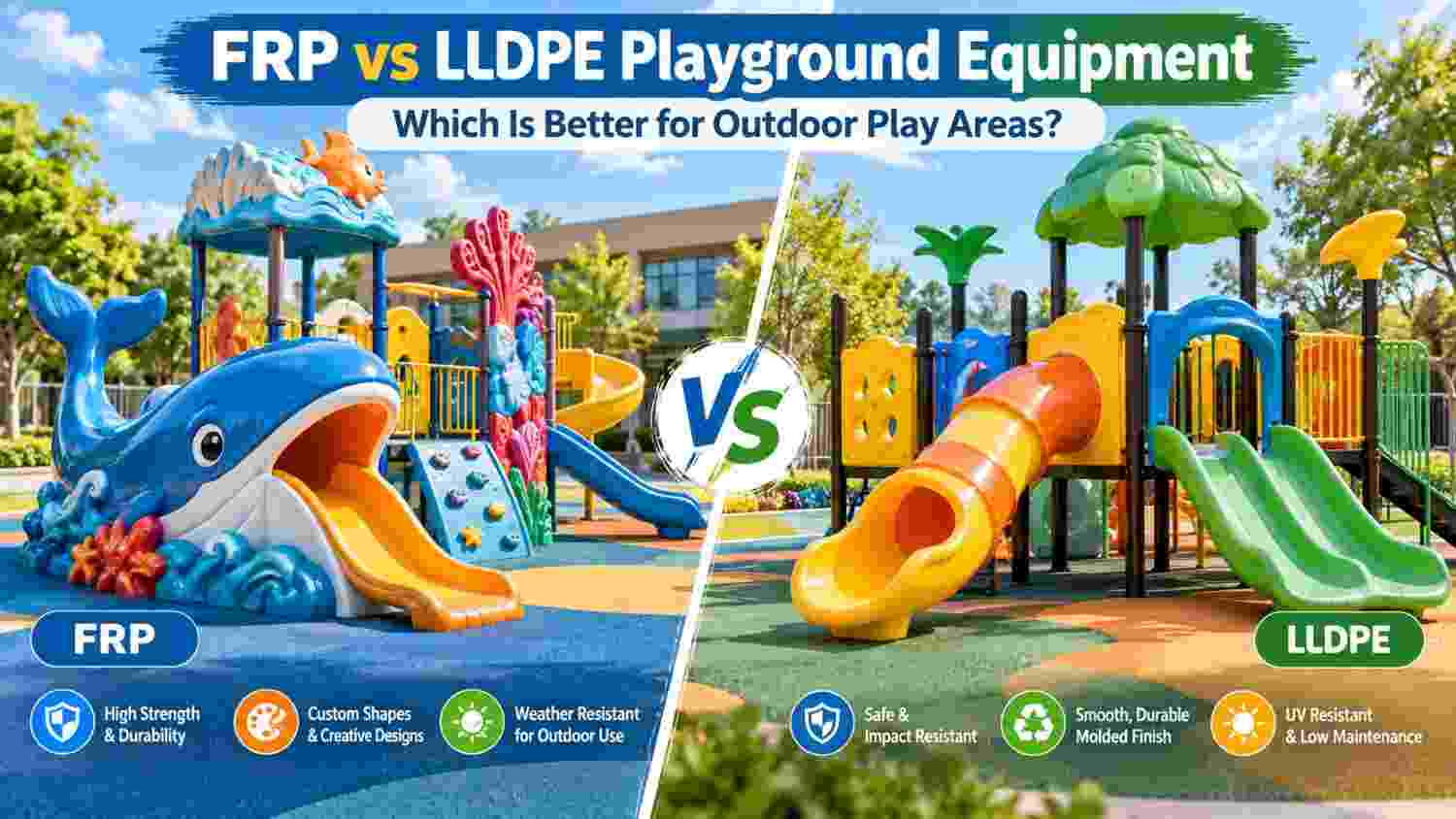
Choosing the right material is one of the most important decisions when planning an outdoor playground.
Schools, residential societies, public parks, resorts, builders, and institutions often compare FRP vs LLDPE playground equipment before finalizing a project.
Both materials are commonly used in outdoor playground systems, but they differ in terms of appearance, durability, flexibility, maintenance, design possibilities, and cost.
So, which one is better?
The answer depends on the type of playground, expected usage, budget, climate, and design requirements.
At G.N. Enterprises, different playground solutions can be planned using suitable materials based on the needs of the project.
This guide explains the key differences between FRP and LLDPE playground equipment to help buyers make a more informed decision.
What Is FRP Playground Equipment?
FRP stands for Fiber Reinforced Plastic.
It is a composite material made by combining a polymer resin with reinforcing fibers. The result is a strong and relatively lightweight material that can be molded into different shapes.
FRP is commonly used in playground components such as:
One of the advantages of FRP is that it can be molded into many different forms, making it useful for customized playground designs.
What Is LLDPE Playground Equipment?
LLDPE stands for Linear Low-Density Polyethylene.
It is a type of plastic commonly used in rotational molding to manufacture playground components with smooth, rounded surfaces.
LLDPE is often used for:
-
Slides
-
Tunnels
-
Roofs
-
Activity panels
-
Playhouse components
-
Climbing elements
-
Multiplay system parts
Because LLDPE components are generally molded as single pieces, they can provide a smooth finish with fewer sharp edges or joints.
This makes LLDPE a popular choice for modern playground systems.
What Is the Main Difference Between FRP and LLDPE Playground Equipment?
The main difference lies in how the two materials are manufactured and how they perform over time.
FRP is a reinforced composite material and can be fabricated or molded into many customized shapes.
LLDPE, on the other hand, is typically rotationally molded into durable, hollow, one-piece components.
In simple terms:
-
FRP offers greater flexibility for custom shapes and theme-based designs.
-
LLDPE usually provides a smoother finish and more consistent molded components.
-
Both can be used effectively when combined with strong metal support structures.
The better option depends on the specific playground application.
Is FRP Playground Equipment Durable?
Yes, FRP can be durable when it is manufactured using good-quality materials and proper fabrication methods.
It can withstand outdoor use and can be suitable for playground components that require customized shapes.
However, long-term durability depends on factors such as:
-
Resin quality
-
Fiber reinforcement
-
Thickness
-
Surface coating
-
Exposure to sunlight
-
Weather conditions
-
Maintenance
Poor-quality FRP may develop surface cracks, fading, or damage over time.
This is why buyers should evaluate manufacturing quality instead of judging the material only by appearance.
Is LLDPE Playground Equipment Durable?
Yes. LLDPE is widely used for outdoor playground equipment because it can handle regular use and different weather conditions.
Good-quality LLDPE components can offer:
Because many LLDPE parts are manufactured as single molded components, there are often fewer joints or seams.
This can improve the overall finish and reduce weak points in some playground applications.
Which Material Is Safer for Children: FRP or LLDPE?
Both materials can be safe when the equipment is properly designed, manufactured, installed, and maintained.
LLDPE is often preferred for slides, tunnels, roofs, and activity panels because it can provide smooth and rounded surfaces.
FRP can also be safe, but the finish quality is extremely important.
Sharp edges, rough surfaces, exposed fibers, or damaged coatings should not be present in finished playground components.
Safety depends not only on material but also on:
-
Equipment design
-
Structural stability
-
Surface finish
-
Fasteners
-
Installation
-
Fall zones
-
Safety flooring
-
Maintenance
A well-designed playground should consider the complete system rather than focusing on a single material.
Which Material Looks Better in a Playground?
This depends on the design style.
LLDPE playground equipment usually has a clean, modern, colourful appearance.
It is commonly available in bright colours and molded shapes suitable for contemporary playgrounds.
FRP can provide greater flexibility for customized themes and creative shapes.
For example, FRP may be used for:
-
Animal shapes
-
Cartoon-style designs
-
Decorative structures
-
Themed playgrounds
-
Custom sculptures
For schools or modern residential projects, LLDPE may provide a more consistent and polished look.
For themed or highly customized projects, FRP may offer more design freedom.
Which Material Is Better for Slides?
Both FRP and LLDPE can be used for playground slides.
FRP slides may be manufactured in different shapes and sizes and can be customized for specific playground designs.
LLDPE slides are often preferred for modern multiplay systems because they are molded with smooth surfaces and rounded edges.
The choice may depend on:
-
Slide height
-
Slide type
-
Playground theme
-
Age group
-
Budget
-
Required design
For high-use projects, it is important to evaluate the manufacturing quality and thickness of the slide material.
Which Material Is Better for Multiplay Systems?
LLDPE is commonly used in modern multiplay systems for non-structural components such as:
-
Slides
-
Roofs
-
Panels
-
Tunnels
-
Decorative elements
The main structural frame is usually made from metal such as mild steel, galvanized iron, or another suitable material.
FRP can also be used in multiplay systems, particularly where custom forms or decorative components are required.
In many cases, the best playground is not purely FRP or purely LLDPE.
A combination of strong metal frames with high-quality molded or fabricated components can provide better overall performance.
Does LLDPE Fade in Sunlight?
Like most materials exposed to outdoor conditions, LLDPE can experience colour changes over time.
However, good-quality playground-grade LLDPE is usually manufactured with UV stabilizers that help improve resistance to sunlight.
The rate of fading can depend on:
-
Material quality
-
UV protection
-
Colour
-
Climate
-
Direct sunlight exposure
-
Maintenance
Buyers should ask the manufacturer whether the LLDPE material includes UV stabilization for outdoor use.
Can FRP Fade or Crack Over Time?
FRP can also be affected by long-term outdoor exposure.
Possible issues may include:
-
Surface fading
-
Gel-coat wear
-
Small cracks
-
Chipping
-
Surface roughness
These problems are more likely when low-quality material or poor fabrication methods are used.
Regular inspection and maintenance can help identify minor damage before it becomes a larger issue.
Which Material Requires Less Maintenance?
LLDPE generally requires relatively low maintenance because molded plastic components do not need painting and are resistant to moisture.
Cleaning is usually straightforward.
FRP may require more attention over time, particularly if surface coatings become damaged.
However, the actual maintenance requirement depends on:
-
Product quality
-
Installation
-
Usage frequency
-
Climate
-
Cleaning
-
Wear and tear
Metal structures, fasteners, bearings, chains, and foundations will also require inspection regardless of whether FRP or LLDPE is used.
Is FRP Cheaper Than LLDPE Playground Equipment?
Not always.
The final cost depends on the equipment design, material quantity, size, manufacturing method, customization, and project scale.
FRP can sometimes be cost-effective for customized designs or smaller production requirements.
LLDPE components often require specialized molding equipment and molds, which can affect manufacturing cost.
However, price should not be the only consideration.
Buyers should compare:
-
Material quality
-
Product thickness
-
Finish
-
Durability
-
Maintenance
-
Safety
-
Expected usage
-
Warranty or support
Choosing the lowest-cost material may not always provide the best long-term value.
Which Material Is Better for Schools?
For schools, both FRP and LLDPE can be suitable depending on the type of equipment.
LLDPE is often a strong choice for frequently used components such as:
-
Slides
-
Tunnels
-
Panels
-
Roofs
Its smooth finish and colourful appearance can work well in school playgrounds.
FRP may be suitable for customized or theme-based equipment where unique shapes are required.
Schools should also consider the age group, number of students, usage frequency, and maintenance requirements before choosing a material.
Which Material Is Better for Public Parks?
Public parks often experience higher usage and need playground equipment that is durable and easy to maintain.
LLDPE components can be useful in high-use playgrounds because of their impact resistance and low-maintenance characteristics.
However, FRP can still be used effectively for selected applications.
For public parks, the most important factors include:
-
Structural strength
-
Durability
-
Weather resistance
-
Safety
-
Ease of maintenance
-
Replacement availability
The overall system quality is more important than choosing one material exclusively.
Which Material Is Better for Residential Societies?
Residential societies generally look for playground equipment that is attractive, compact, durable, and suitable for regular use.
LLDPE multiplay systems are often popular because they offer bright colours, modern designs, and smooth molded components.
FRP can be useful when the society wants a unique theme or customized design.
The final choice should depend on:
-
Available space
-
Number of children
-
Budget
-
Design preferences
-
Maintenance expectations
Can FRP and LLDPE Be Used Together?
Yes.
In many playground projects, multiple materials are used together.
A typical playground structure may include:
Using different materials allows the manufacturer to choose the most suitable material for each component.
This can improve durability, functionality, appearance, and overall value.
What Should Buyers Check Before Choosing FRP or LLDPE Playground Equipment?
Before selecting playground equipment, buyers should evaluate more than just the material name.
Important questions include:
-
What is the material grade?
-
What thickness is used?
-
Is the material suitable for outdoor use?
-
Is UV protection included?
-
What metal is used in the frame?
-
How is the equipment finished?
-
Are edges smooth and rounded?
-
What maintenance is required?
-
Is installation support available?
-
Can replacement components be provided?
These questions can help buyers compare manufacturers more effectively.
Which Is Better: FRP or LLDPE Playground Equipment?
There is no single answer that applies to every project.
Choose FRP playground equipment when:
-
Customized shapes are important
-
Theme-based designs are required
-
Unique decorative components are needed
-
Design flexibility is a priority
Choose LLDPE playground equipment when:
-
Smooth molded components are preferred
-
Modern multiplay systems are required
-
Low maintenance is important
-
Consistent colours and shapes are desired
In many projects, a combination of materials may provide the best result.
How Can G.N. Enterprises Help You Choose the Right Playground Material?
G.N. Enterprises provides playground equipment solutions for schools, parks, residential societies, institutions, resorts, and other recreational spaces.
Depending on the project, equipment can be planned using suitable combinations of:
The right combination depends on the playground layout, expected usage, age group, project budget, and design requirements.
Final Thoughts
When comparing FRP vs LLDPE playground equipment, buyers should focus on overall quality rather than choosing a material based only on price.
FRP offers flexibility and customization, while LLDPE provides smooth molded components, modern aesthetics, and relatively low maintenance.
Both materials can perform well when they are manufactured correctly and used in the right application.
For schools, public parks, residential societies, resorts, and commercial projects, the best approach is to evaluate the complete playground system, including structural strength, material quality, safety, installation, and long-term maintenance.